Airport Transfer Red Flags List: Stay Safe in 2026

Airport transfer red flags are specific warning signs that reveal a service is unreliable, fraudulent, or likely to leave you stranded. Recognizing these signals before you book or board protects your money, your luggage, and your safety. In 2026, the Port Authority of New York and New Jersey deployed 70 enforcement personnel at JFK and LaGuardia specifically to combat illegal taxi solicitation. That scale of enforcement tells you one thing clearly: airport transfer scams are not rare edge cases. They are a documented, organized problem that targets travelers every day.
What are the key red flags in airport transfer services?
The most dangerous warning signs fall into three categories: website legitimacy, pricing transparency, and driver behavior. Spotting even one of these signals before you commit is enough reason to walk away.
Website and booking red flags:
- Fraudulent transfer websites use URLs with slight variations from official airport domains, clone logos, and show poor grammar throughout
- No physical business address listed anywhere on the site
- No published terms and conditions or cancellation policy
- Suspicious social media presence with few followers and no verification
- No licensing or regulatory information displayed
Pricing and policy red flags:
- No fixed price quoted upfront. Any service that refuses to give you a total before you board is a risk
- Vague or missing refund terms. Unclear waiting time and cancellation policies signal an unreliable operator
- No explanation of what affects the final price, such as tolls, baggage, or child seats
- Requests for payment via cryptocurrency, gift cards, or wire transfer
Driver and communication red flags:
- Driver contacts you through a personal phone number or messaging app instead of the official booking platform
- No vehicle plate number or driver photo provided before pickup
- Driver cannot show identification or a printed booking confirmation on request
- Unsolicited approach inside the terminal before you reach the official pickup zone
Pro Tip: Screenshot your booking confirmation, the driver’s name, and the vehicle plate before you travel. If anything changes on arrival, you have a paper trail.
A company that responds professionally to negative reviews is a stronger trust signal than a perfect star rating. Any operator with only five-star reviews and zero responses to complaints deserves extra scrutiny.

How airport transfer scams operate at the terminal
Scams at the airport follow predictable patterns. Knowing the script in advance makes you nearly impossible to target.
-
The unsolicited approach. An unofficial driver approaches you inside the baggage claim area, often before you reach the official taxi or transfer zone. They offer help with luggage to create a sense of obligation before quoting a price.
-
The urgency tactic. Urgency scams create false pressure with claims like “last car available” or “this deal ends in two minutes.” The goal is to stop you from thinking clearly or checking credentials.
-
The distraction offer. Someone offers to help you translate, find your gate, or carry your bags. While you are distracted, an accomplice may access your luggage or personal items.
-
The bag-holding request. A stranger asks you to watch their bag or carry an item for them. Never agree to hold a stranger’s bag at an airport. This tactic can be used to facilitate theft or, in serious cases, to implicate you in illegal possession.
-
The broken meter claim. You board what appears to be a legitimate cab, and the driver claims the meter is broken. They then name an inflated flat rate once you are already moving.
-
The hidden surcharge reveal. The quoted price changes after arrival. The driver adds charges for tolls, late-night fees, or extra luggage that were never disclosed at booking.
-
The fake official counter. Scammers set up unofficial desks inside terminals that mimic the look of licensed taxi dispatch counters. Always verify the counter displays official airport branding and regulatory signage.
“Most airport transport scams target travelers at their most vulnerable, tired and distracted. Maintaining vigilance with a pre-arrival caution script is the best defense. Never accept unsolicited rides, verify driver identity before boarding, and do not hand over your luggage or phone to anyone you did not pre-arrange contact with.”
The pre-arrival script approach is not overcautious. It is the single most effective behavioral tool for avoiding common airport transfer pitfalls. Decide before you land exactly where your pickup point is, what your driver’s name is, and what the vehicle looks like.
What to verify before you prepay for an airport transfer
Prepaying locks in your commitment. That makes pre-booking verification the highest-leverage step you can take. Prepaying without clear operator identity or a flight-tracking policy increases your risk of no-shows and lost refunds significantly.
Verification checklist before you pay:
- Confirm the actual operating company name, not just the booking platform’s name
- Get a direct phone number for the operator, not a generic support email
- Ask whether the service tracks your flight number for automatic delay adjustments
- Clarify the exact pickup location, including terminal, floor, and meeting point
- Confirm what passenger count and baggage volume affect the final price
- Ask for the cancellation window and refund timeline in writing
- Verify that payment methods include a consumer-protected option such as a credit card
Pro Tip: If a company only offers email support and takes 24 hours to respond to a pre-booking question, expect the same response time when your flight lands at midnight and your driver is missing.
Booking platforms and actual operators are often different companies. The platform takes your money; the operator provides the car. If the operator’s identity is unknown to you, your recourse in a no-show situation is limited to the platform’s dispute process, which can take days.
| Question to ask | What a trustworthy answer looks like |
|---|---|
| Who is the actual operator? | A named company with a verifiable license number |
| Do you track my flight? | Yes, with automatic delay adjustment and no extra charge |
| Where exactly do I meet the driver? | Specific terminal, floor, and signage description |
| What is your cancellation policy? | Clear window (e.g., 24 hours) with a written refund timeline |
| What payment methods do you accept? | Credit card or other consumer-protected method |
For a full walkthrough of due diligence steps, the guide on how to prepay safely covers each verification point in detail.
How pricing structures and service categories hide red flags
Not all airport transfer services carry equal risk. The category of service you book determines the type of red flags you are most likely to encounter.
Booking platforms vs. direct operators. Marketplace platforms aggregate listings from multiple operators. The convenience is real, but so is the accountability gap. When something goes wrong, the platform may redirect you to the operator, and the operator may redirect you back. Direct bookings with licensed operators give you one point of contact and one clear chain of responsibility.
Fixed fare vs. metered services. Fixed fares eliminate the broken-meter scam entirely. Metered services are legitimate in many cities, but they create opportunity for route manipulation and surcharge additions. Always confirm whether your quoted price is fixed or estimated before boarding.
Unlicensed and subcontracted drivers. Some services advertise premium vehicles but subcontract to unlicensed drivers on busy travel days. Ask directly whether the driver who shows up will be employed by the company you booked or sourced from a third party.
Hidden surcharge categories to watch for:
- Airport parking or drop-off fees passed to the traveler
- Toll charges not included in the quoted price
- Child seat or booster fees added at pickup
- Late-night or early-morning time surcharges
- Extra baggage fees for oversized or additional luggage
Pro Tip: Overly low prices are a reliable red flag, not a deal. A rate that is significantly below the market average for a route almost always means unlicensed operation, subcontracting, or hidden fees that appear after you board.
Reading the fine print on cancellation policies reveals a lot. A policy that requires 72 hours notice for a full refund on a booking made 48 hours before travel is effectively a no-refund policy. Legitimate operators offer clear, proportional cancellation terms. For a practical comparison of what credible providers look like, the 2026 airport car service guide outlines the identity verification and tracking standards that separate reliable services from risky ones.
Key Takeaways
Unreliable airport transfers share a consistent set of warning signs: missing licensing, vague pricing, no operator transparency, and high-pressure tactics at the terminal.
| Point | Details |
|---|---|
| Verify the operator before paying | Confirm the actual company name, license number, and a direct phone contact before committing. |
| Fixed pricing removes key scam risk | A confirmed fixed fare eliminates meter manipulation and post-ride surcharge surprises. |
| Urgency is a tactic, not a reality | Any driver or counter claiming the “last car” is available uses pressure to bypass your judgment. |
| Review responses reveal reliability | A company that answers complaints professionally is more trustworthy than one with only perfect ratings. |
| Pre-arrival preparation is your best defense | Decide your pickup point, driver name, and vehicle details before you land to avoid terminal distractions. |
What I’ve learned from watching travelers ignore the obvious
I have spent years watching travelers make the same mistakes at airports across Europe and North America. The pattern is consistent. The red flags were visible. The traveler was just too tired or too rushed to act on them.
The most overlooked warning sign is not a fake website or a broken meter. It is operator opacity. When you cannot get a straight answer about who will actually drive you, that is the moment to cancel. Most travelers accept vague answers because they want the booking to work out. That optimism is exactly what scammers count on.
Urgency pressure is the second most underestimated tactic. I have seen experienced travelers accept rides from unofficial drivers simply because someone created a sense of time pressure. The countermove is simple: pause, walk to the official information desk, and let the pressure dissolve. No legitimate transfer service disappears in 90 seconds.
Triple-confirming driver and vehicle identity before you get in the car sounds excessive until the one time it saves you. Check the name on your booking against the name the driver gives you. Check the plate against what was sent to you. If either does not match, do not get in. This takes 30 seconds and eliminates a category of risk entirely.
The travelers who avoid airport transfer scams are not more suspicious by nature. They are more prepared. They did the verification work before arrival and arrived at the terminal with a clear plan. That preparation is the difference between a smooth transfer and a story you tell as a warning.
— Arthur
Why Zont Cab travelers skip this checklist entirely
Zont Cab is built around the problems this article describes. Every booking includes a named, licensed driver, a confirmed vehicle plate sent in advance, and real-time flight tracking that adjusts automatically for delays. Pricing is fixed before you confirm, with no hidden fees for tolls, luggage, or late arrivals.
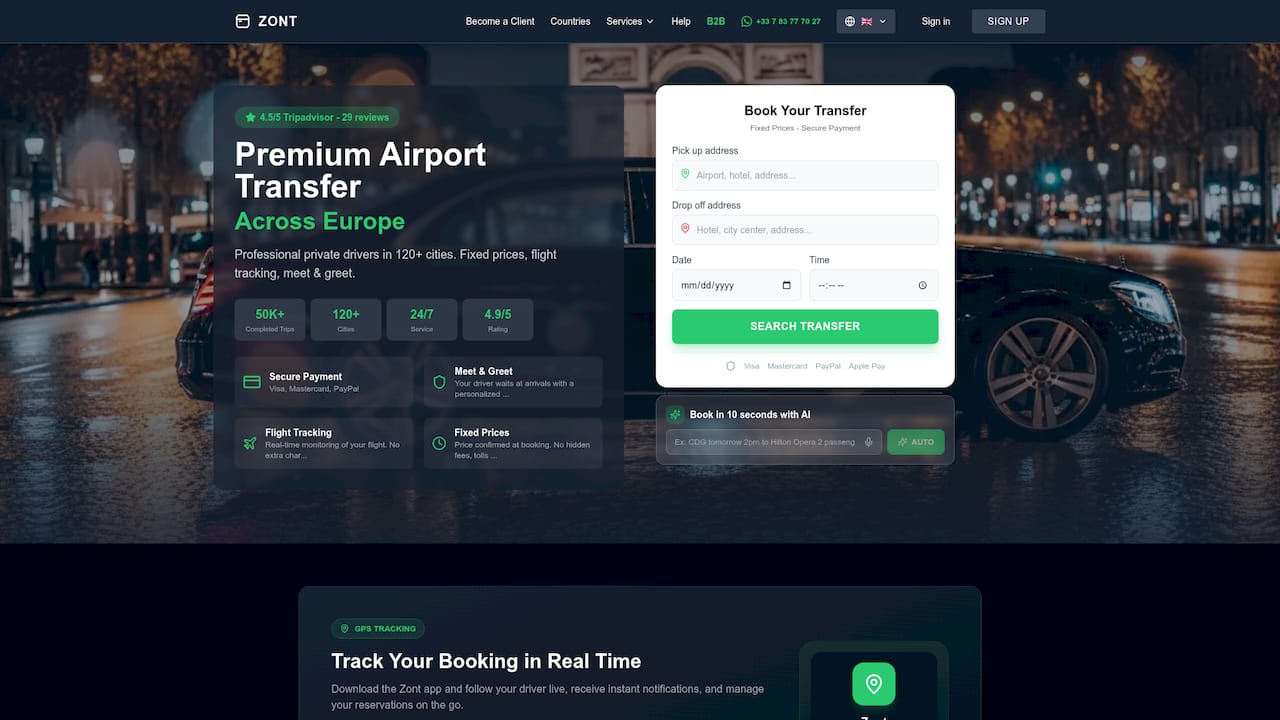
Zont Cab operates across more than 120 cities in Europe, with direct operator contact available for every trip. Travelers reach the actual driver’s team on the day of travel, not a call center. With over 50,000 completed trips and a 4.5-star rating on TripAdvisor, Zont Cab’s track record speaks for itself. When every item on the airport transfer red flags list is already handled by your provider, you can focus on the trip instead of the transfer.
FAQ
What is the most common airport transfer scam?
The most common scam is unsolicited driver solicitation inside the terminal, where unofficial drivers approach tired travelers and charge inflated rates with no accountability. The Port Authority deployed 70 enforcement personnel at JFK and LaGuardia in 2026 specifically to address this problem.
How do I verify an airport transfer company is legitimate?
Confirm the company’s license number, physical business address, and a direct operator phone number before paying. Legitimate services also provide a fixed price, a named driver, and a vehicle plate in advance.
What payment methods are safest for airport transfers?
Credit cards offer the strongest consumer protection because they allow chargebacks if the service fails. Avoid services that request cryptocurrency, gift cards, or wire transfers, as these are common airport transfer scam payment methods with no recourse.
What should I do if a driver approaches me unsolicited at the airport?
Decline immediately and walk to the official taxi or transfer desk inside the terminal. Urgency claims and unsolicited offers are pressure tactics designed to bypass your judgment.
Is it safe to book airport transfers through marketplace platforms?
Marketplace platforms can be convenient, but they often separate you from the actual operator. Always ask for the operator’s name and direct contact before prepaying, since accountability gaps between platforms and operators are a leading cause of no-shows and unresolved disputes.