Executive Airport Pickup Protocol Guide for 2026

An executive airport pickup protocol is a standardized set of procedures that guarantees punctual, professional, and disruption-free transportation for business travelers and C-suite executives. Without a formal protocol, even a single missed detail, like a wrong terminal or an unreachable driver, can derail a high-stakes arrival. C-suite travelers represent only 8–12% of company headcount but consume 25–35% of total corporate travel budgets. That spending concentration makes every pickup a business-critical event, not a logistical afterthought.
What does an executive airport pickup protocol guide cover?
Effective executive transport guidelines answer five core questions before the traveler ever lands: who is traveling, where exactly they arrive, what vehicle and service level they need, how the chauffeur will identify them, and who to call if anything goes wrong. Advance communication between traveler, chauffeur, and coordinators creates a frictionless handoff environment. Skipping any one of these questions introduces risk. A protocol converts those questions into a repeatable checklist that every coordinator, travel manager, and chauffeur follows without exception.
The five core questions every coordinator must answer
The “who, where, what, how, and who” framework is the foundation of any airport pickup procedure. It forces coordinators to gather specific data rather than rely on assumptions. Each question maps directly to a booking field, a communication step, or a contingency plan.

What information do you need before the executive arrives?
Pre-arrival preparation is the single most important phase of any VIP airport transfer method. Errors made here cannot be fixed at the curb. Collect and verify the following details at the time of booking:
- Traveler identity: Full legal name as it appears on the ticket, plus a direct mobile number confirmed active with international roaming.
- Flight details: Airline name, flight number, origin city, and scheduled arrival time.
- Arrival point: Airport name, terminal number, and specific exit or baggage claim door. Flight number alone is insufficient; terminal and exit details are critical to avoid delays in large airports.
- Baggage status: Number of checked bags and any oversized items that affect vehicle selection.
- Service type: Curbside pickup or meet-and-greet inside the terminal. These require different chauffeur positioning and timing.
- Vehicle selection: Match the vehicle to the number of passengers and luggage volume. A solo traveler with two large bags needs a different vehicle than a delegation of four.
- Chauffeur assignment: Named chauffeur with direct mobile contact and a backup escalation contact.
- Waiting time policy: Define the grace period and any additional charges before the booking is confirmed.
Explicitly requesting a mobile active while roaming prevents the most common communication failure during international arrivals. A traveler who lands and cannot receive calls or texts is effectively unreachable at the worst possible moment.
Pro Tip: Send the traveler a one-page pre-arrival brief 24 hours before departure. Include the chauffeur’s name, photo, mobile number, vehicle make and license plate, and the exact meeting point with a landmark or door number.
How do you execute the pickup smoothly at the airport?
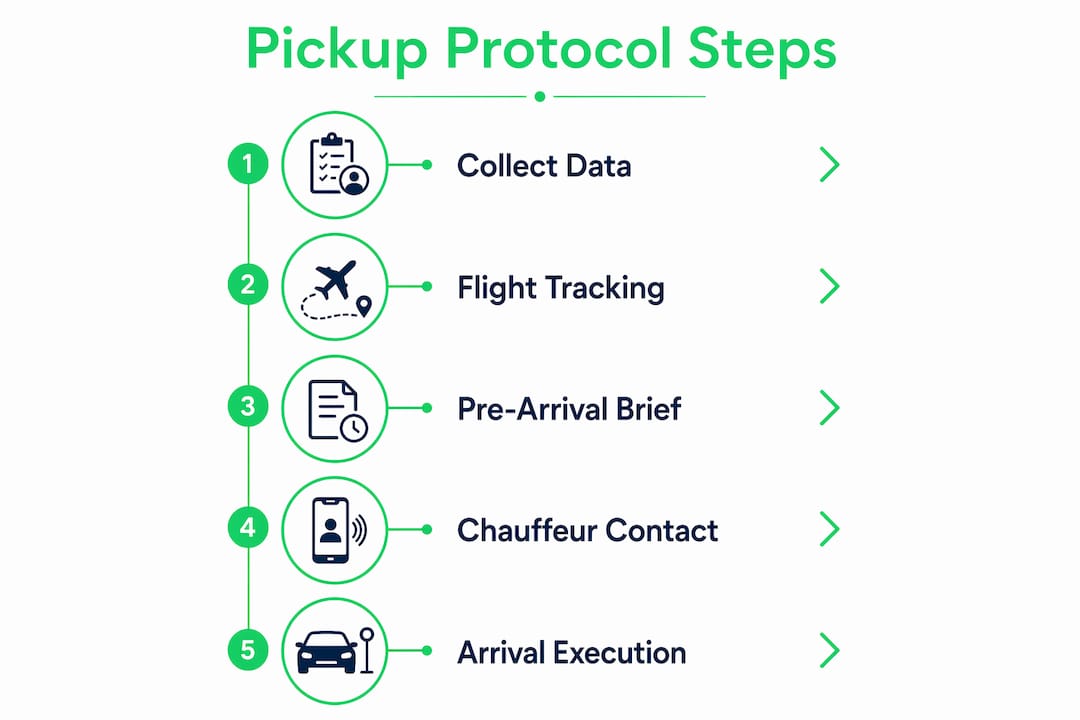
Execution is where preparation either pays off or falls apart. A well-briefed chauffeur following a clear protocol makes the pickup invisible to the traveler. A chauffeur improvising without instructions creates friction and erodes confidence. Follow these steps in order:
- Monitor the flight in real time. Flight tracking services reduce uncertainty by monitoring changes and automating driver notifications. The chauffeur adjusts arrival time based on actual landing data, not the scheduled time.
- Communicate the exact pickup location. Send the traveler the specific door number, curbside zone, or arrivals hall landmark before the plane lands. Generic instructions like “arrivals level” cause confusion in multi-terminal airports.
- Position the chauffeur correctly. The chauffeur arrives at the designated point before the traveler clears customs. For meet-and-greet service, the chauffeur enters the arrivals hall with a clearly visible name board.
- Present proper identification. Professional chauffeur protocols include proper identification, traveler recognition, and luggage assistance. A name board is the minimum standard. A photo of the traveler shared with the chauffeur in advance eliminates recognition errors.
- Confirm identity and destination. The chauffeur greets the traveler by name, confirms the destination, and offers luggage assistance. This step takes 30 seconds and prevents the wrong person from entering the vehicle.
- Handle luggage professionally. The chauffeur loads bags without being asked. Travelers should not carry their own luggage to the vehicle.
- Depart without delay. Once the traveler is seated and luggage is loaded, the chauffeur departs immediately. Any route or timing questions are resolved before the traveler boards.
Pro Tip: Never assume the traveler knows which service type was booked. Confirm in the pre-arrival brief whether the chauffeur will meet them inside the terminal or at the curb. Ambiguity at this stage causes travelers to exit at the wrong point and miss their driver entirely.
How do you handle delays, missed connections, and communication breakdowns?
Disruptions are not exceptional events in executive travel logistics. They are predictable variables that a protocol must account for in advance. The difference between a minor inconvenience and a failed pickup is whether a contingency plan exists before the disruption occurs.
- Flight delays: The chauffeur monitors the flight and adjusts automatically when tracking is active. No manual intervention is needed for standard delays. The coordinator receives an alert if the delay exceeds a defined threshold.
- Diversions or cancellations: Establish a named escalation contact who has authority to rebook ground transport immediately. The traveler should have this contact’s number before departure.
- Early arrivals: Clear waiting time policies with defined charges and limits prevent confusion when the traveler lands ahead of schedule. The chauffeur is already on site; the policy defines what happens if the traveler exits early.
- Communication failure: If the traveler’s mobile is unreachable, the chauffeur waits at the designated point for the full grace period, then contacts the coordinator. Pre-trip escalation plans with named contacts provide a crucial fallback when primary communication methods fail.
- Terminal navigation: Large airports like Frankfurt or Charles de Gaulle have multiple terminals and sub-terminals. The coordinator specifies the exact terminal code and exit number in writing. Verbal instructions are not sufficient.
“Meticulous written protocols advance duty of care and reduce operational risks in executive travel. The no-surprise rule is the foundation of every secure executive pickup: every party knows exactly where to be, when to be there, and who to call if anything changes.”
This principle applies equally to corporate travel managers and professional chauffeur services. When you evaluate what to look for in a corporate chauffeur service, the presence of written contingency protocols is a non-negotiable criterion.
What are the best practices for confirming protocols with all parties?
Alignment between the coordinator, chauffeur, and traveler is the final layer of a complete airport pickup procedure. Even a perfect checklist fails if the information stays in one person’s inbox. The table below outlines the communication structure that prevents handoff failures.
| Communication step | Recipient | Timing | Content |
|---|---|---|---|
| Pre-arrival brief | Traveler | 24 hours before departure | Chauffeur name, photo, mobile, vehicle, meeting point |
| Chauffeur briefing sheet | Chauffeur | 2 hours before pickup | Traveler name, photo, flight number, terminal, exit, destination, special instructions |
| Internal provider sheet | Coordinator | Updated quarterly | Escalation contacts, waiting time policy, billing rules, traveler preferences |
| Confirmation message | Traveler | Upon landing | “Your driver [Name] is at [exact location]. Call [number] if needed.” |
The internal provider sheet deserves particular attention. It functions as the single source of truth for recurring executive travelers. Quarterly reviews of traveler profiles capture updated preferences, new mobile numbers, and changes in vehicle requirements. A traveler who switched from sedan to SUV six months ago should not arrive to find the wrong vehicle waiting.
Pro Tip: Include a “what to do if you cannot find your driver” instruction in every pre-arrival brief. Tell the traveler to call the chauffeur’s direct number first, then the coordinator’s number. A traveler who knows exactly what to do in a worst-case scenario stays calm and resolves the issue in minutes.
The benefits of executive airport transfers extend well beyond comfort. Documented protocols protect the company’s duty of care obligations and give travel managers a defensible record of every pickup decision.
Key Takeaways
A complete executive airport pickup protocol requires verified pre-arrival data, real-time flight tracking, written communication to all parties, and documented contingency plans before the traveler lands.
| Point | Details |
|---|---|
| Pre-arrival data is non-negotiable | Collect flight number, terminal, exit door, baggage count, and a roaming-active mobile before confirming any booking. |
| Flight tracking prevents reactive scrambling | Real-time monitoring lets the chauffeur adjust automatically, removing the coordinator from every minor delay. |
| Written briefs eliminate ambiguity | Send the traveler and chauffeur separate written briefs with exact meeting points, names, and escalation contacts. |
| Contingency plans must be named | Every protocol needs a named escalation contact with authority to act, not just a general “contact the office” instruction. |
| Quarterly profile reviews maintain accuracy | Traveler preferences, mobile numbers, and vehicle requirements change. Review recurring profiles every quarter. |
Why the details most coordinators skip are the ones that matter most
I have reviewed airport pickup failures across dozens of corporate travel programs, and the pattern is always the same. The booking was made. The chauffeur was assigned. The flight was tracked. But nobody told the traveler which exit to use, or nobody confirmed the mobile number was active abroad. Those two omissions caused the failure, not the absence of a vehicle.
The no-surprise rule from executive protection practice is the most underused concept in corporate ground transport. Security professionals apply it to every principal movement: every party knows exactly where to be, when, and what to do if the plan changes. Corporate travel coordinators apply it inconsistently, usually because the protocol lives in someone’s head rather than in a written document.
The terminal and exit specification is the detail I see skipped most often. A coordinator books a pickup at “JFK arrivals” without specifying Terminal 4, Door 4. The chauffeur waits at Door 1. The traveler exits at Door 4. Both parties call each other while walking in opposite directions. The fix takes 30 seconds to implement and zero dollars to maintain.
The other underestimated risk is the roaming mobile. An executive who lands in Frankfurt with a US SIM card on a carrier that does not activate international roaming automatically is unreachable. The chauffeur waits. The coordinator cannot reach the traveler. The pickup fails. Confirming roaming capability at the time of booking costs nothing and prevents a category of failure that no amount of driver skill can fix.
My recommendation: treat every executive pickup as if the traveler has never used ground transport before. Write out every instruction. Name every contact. Specify every location. The protocol should be so complete that a new coordinator could execute it correctly on their first day.
— Arthur
Zont Cab’s approach to executive airport transfers
Executives who need a reliable, documented pickup process across European cities use Zont Cab’s corporate transfer services as their operational standard. Zont Cab combines real-time flight tracking, professional meet-and-greet chauffeurs, and fixed pricing with no hidden fees across more than 120 cities in Europe.
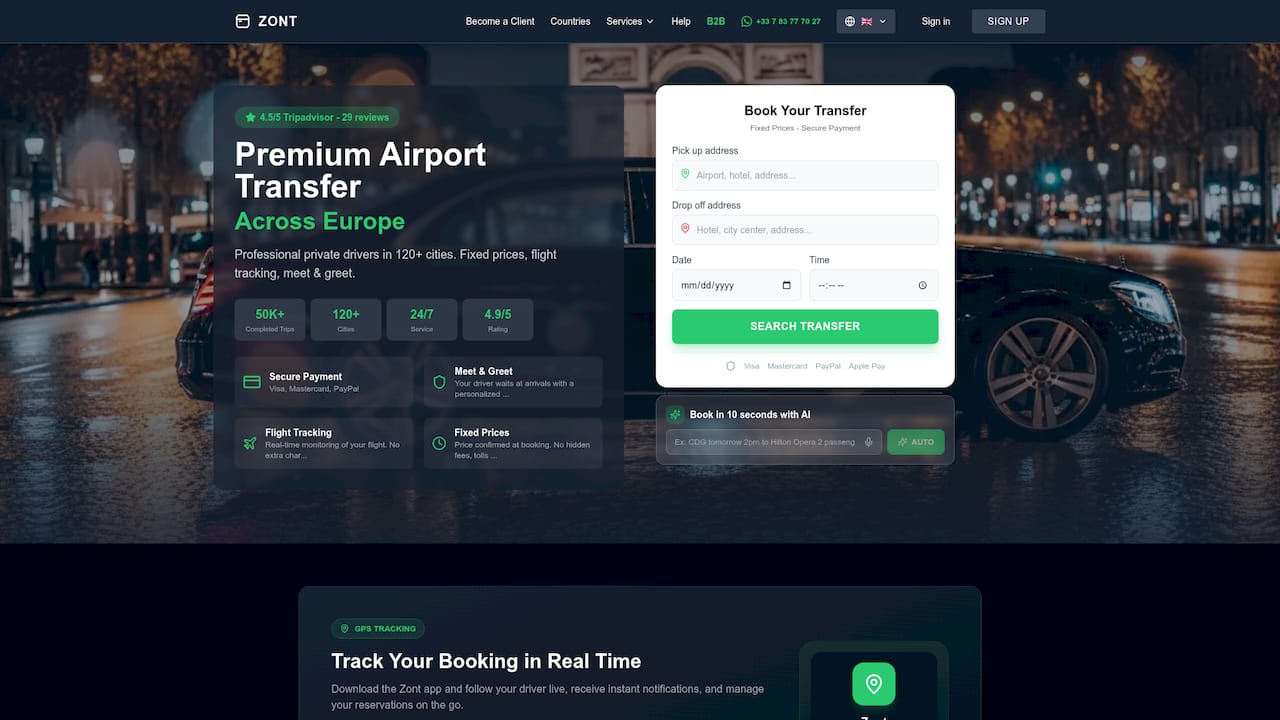
Every Zont Cab booking includes a named chauffeur, direct contact details, and automatic flight monitoring so the driver adjusts to actual landing times without coordinator intervention. The service has completed over 50,000 trips and holds a 4.5-star rating from verified TripAdvisor reviews. For executives who need consistent, documented ground transport across European destinations, Zont Cab delivers the protocol-grade reliability that corporate travel programs require.
FAQ
What is an executive airport pickup protocol?
An executive airport pickup protocol is a documented set of procedures covering pre-arrival data collection, chauffeur briefing, real-time flight monitoring, traveler recognition, and contingency management. It converts a high-risk logistical event into a repeatable, predictable process.
What details must be confirmed before an executive’s flight lands?
Coordinators must confirm the traveler’s full name, a roaming-active mobile number, flight number, airline, terminal, specific exit or baggage claim door, baggage count, vehicle type, and the chauffeur’s direct contact before the flight departs.
How does flight tracking improve executive airport pickups?
Flight tracking services monitor real-time changes and send automatic notifications to the chauffeur, eliminating the need for manual coordinator intervention on standard delays and allowing the driver to adjust arrival time based on actual landing data.
What should a pre-arrival brief include?
A pre-arrival brief sent to the traveler 24 hours before departure should include the chauffeur’s name, photo, direct mobile number, vehicle make and license plate, exact meeting point with a landmark or door number, and instructions for what to do if the driver cannot be located.
How do you handle a missed connection or flight diversion?
A named escalation contact with authority to rebook ground transport immediately is the correct response to a diversion or cancellation. The traveler should have this contact’s number before departure, and the coordinator should have a written policy covering rebooking timelines and additional charges.