Chauffeur vs Driver: Which Should You Hire and When?

A professional chauffeur is a trained, contract-bound service specialist who delivers concierge-level care alongside the drive itself; a driver is someone who operates a vehicle to move passengers from point A to point B. For business meetings, airport connections, weddings, or any trip where timing, image, or privacy matters, book a chauffeur. For casual, low-stakes city runs, a standard driver or rideshare is usually enough.
Quick decision rules:
- Hard deadline or flight connection? A chauffeur is assigned hours in advance and treats the pickup as a contractual obligation, not an optional match.
- Confidential conversations or photographed arrival? Chauffeurs operate under employer-enforced NDAs and arrive in inspected, premium vehicles.
- Casual errand or short city hop? A standard driver gets the job done at a lower price point.
Table of Contents
- How a professional chauffeur differs from a driver
- What training and qualifications actually separate chauffeurs
- What service features do chauffeurs provide that drivers usually don’t?
- What vehicle standards should you expect from a chauffeur service?
- Licensing, insurance, and legal considerations in the U.S.
- How chauffeur pricing works and what drives the cost
- When should you book a chauffeur versus a regular driver?
- How to choose between a chauffeur service and a standard driver
- What a premium chauffeur service looks like in practice: Zont Cab
- Key Takeaways
- The case for choosing carefully, not just cheaply
- Zont Cab: fixed-price chauffeur transfers across Europe
- Useful sources
How a professional chauffeur differs from a driver
Chauffeur traces back to the French word for “stoker” and has meant a professional, for-hire operator of passenger vehicles since the early automobile era. Today it specifically describes someone employed or contracted to drive luxury sedans, SUVs, or limousines as a service role, not just a transport role. A driver, by contrast, is anyone who operates a vehicle, from a delivery courier to a rideshare contractor to a personal errand runner.

The practical gap between the two is wider than most travelers expect.
| Dimension | Professional chauffeur | Standard driver |
|---|---|---|
| Service scope | Concierge: luggage, door, itinerary | Point-to-point transport |
| Assignment | Named, advance-dispatched | Matched at moment of request |
| Contractual obligation | Operator-level commitment | Trip-by-trip acceptance |
| Confidentiality | Employer-enforced NDA | No formal confidentiality |
| Vehicle standard | Inspected luxury class | Variable |
| Training | Defensive driving, etiquette, vetting | Standard license |
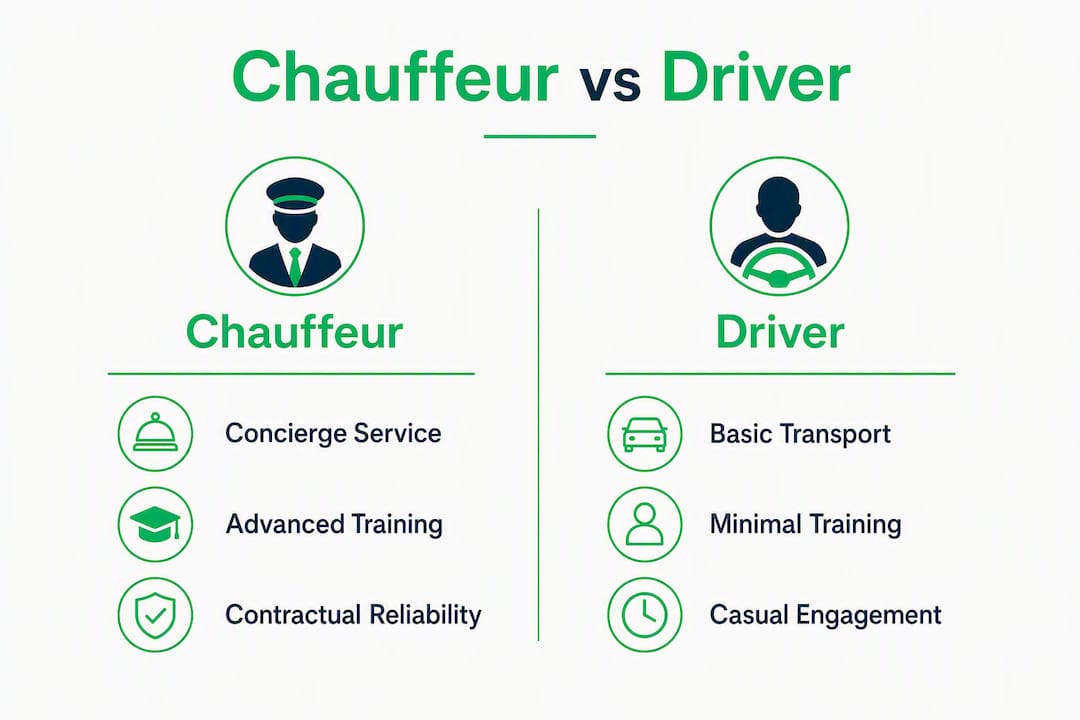
The contractual difference is the one most travelers overlook. A professional chauffeur operator assigns a chauffeur hours before the booking window and treats a late-night pickup as an obligation, not a preference. Rideshare marketplaces match a driver at the moment of the request, and that driver can decline or cancel without any operator-level consequence to the platform.
What training and qualifications actually separate chauffeurs
The skills gap between a chauffeur and a typical driver shows up in four areas: formal training, background screening, soft skills, and continuing education.
Formal training areas chauffeurs typically complete:
- Defensive and advanced driving techniques, including low-speed maneuvering in tight urban environments
- Route planning and real-time traffic management, often with backup routes pre-loaded
- Passenger etiquette: door sequencing, luggage handling, communication protocols
- Privacy and discretion training, including how to handle third-party inquiries
- Vehicle presentation: pre-trip inspection, interior cleanliness standards, amenity setup
Screening and vetting: A chauffeur’s license or for-hire endorsement typically adds background checks, a knowledge test, and in some states formal defensive driving training on top of a standard license. Many operators also require drug testing and annual motor vehicle record reviews.
Soft skills are where the experience diverges most visibly for passengers. A chauffeur who handles luggage without being asked, holds an umbrella at the curb in the rain, and stays silent unless spoken to is delivering a service product, not just a ride. These behaviors are trained, not incidental, and they are what industry operators describe as the core distinction between the two roles.
Pro Tip: When booking, ask the operator directly: “Are your chauffeurs W-2 employees or independent contractors?” W-2 status means the operator controls training standards and can enforce conduct policies. A contractor-only fleet is a yellow flag for consistency.
What service features do chauffeurs provide that drivers usually don’t?
The clearest way to see the differences between chauffeurs and drivers is to list what a chauffeur service actually delivers beyond the drive.
Concierge features common to professional chauffeur services:
- Flight monitoring: Departure delays, gate changes, and early arrivals are tracked in real time. The chauffeur adjusts without the passenger lifting a finger. For more on how this works in practice, see what travelers need to know about meet and greet.
Continuity is an underrated benefit for frequent travelers. Because chauffeurs are assigned in advance and often employed directly, operators can save passenger preferences, preferred routes, and communication styles across repeat bookings. A rideshare platform cannot do this because the driver who picked you up Monday has no connection to the driver who accepts Tuesday’s request.
Service premium: Professional chauffeur services typically charge a 50–100% premium over premium rideshare tiers in exchange for a named chauffeur, advance dispatch, and higher service consistency.
For corporate travelers, the benefits of executive airport transfers go beyond comfort. Missed connections and last-minute cancellations carry real costs in rescheduled meetings and rebooking fees.
What vehicle standards should you expect from a chauffeur service?
Vehicle quality is one of the most visible differences in the chauffeur vs driver comparison, and it is also one of the easiest to verify before you book.
What a professional chauffeur service’s vehicle should meet:
- Age and class: Typically late-model luxury sedans (Mercedes E-Class, S-Class, BMW 7 Series), SUVs, or minivans. Not a five-year-old economy car with a phone mount.
- Interior condition: Spotless, with no food odors, no personal items visible, and climate pre-set before pickup.
- Commercial inspection: Vehicles in professional fleets are serviced on scheduled maintenance cycles and inspected for commercial use, not just personal roadworthiness.
- Amenities: Bottled water, phone chargers, and privacy partitions are standard in many premium fleets. These are not extras; they are part of the service product.
- Safety equipment: Properly maintained seatbelts, airbags, and first-aid kits where required by the operator’s commercial policy.
For events where your arrival is photographed, the vehicle is part of the image. Arriving at a wedding or a board meeting in a clean, late-model Mercedes S-Class sends a different signal than stepping out of a generic sedan. This is not vanity; it is brand management.
Licensing, insurance, and legal considerations in the U.S.
Licensing for passenger-for-hire transport in the United States runs on three separate tracks, and the right one depends on vehicle size and jurisdiction.
Licensing snapshot: Roughly half of U.S. states issue a specialized for-hire or chauffeur endorsement for sedans, SUVs, and small limousines. Other states route all commercial passenger transport through a CDL with a passenger endorsement, which is typically required for vehicles carrying 16 or more passengers. Rideshare and TNC (transportation network company) rules form a third track, governed by state PUC or DMV regulations.
Why insurance differences matter to you as a passenger:
A standard personal auto policy does not cover commercial passenger transport. Professional chauffeur operators carry commercial general liability and, in most states, hired-car or livery insurance. If an operator cannot produce a certificate of insurance on request, that is a hard stop. The Federal Motor Carrier Safety Administration (FMCSA) sets minimum insurance requirements for certain interstate passenger carriers; state-level rules often go further.
Employment status and confidentiality: A chauffeur service that employs drivers as W-2 workers can bind them to NDAs through employment agreements. Independent contractors on a marketplace platform have no such obligation, which is why NDA-grade discretion is a chauffeur-service feature, not a rideshare feature. For executives, legal teams, or anyone traveling with sensitive information, that distinction carries real liability weight.
Pro Tip: Before you book, ask for the operator’s certificate of insurance and confirm the endorsement type matches your state’s for-hire rules. Your state DMV’s for-hire or livery licensing page is the fastest place to verify what the correct endorsement looks like.
How chauffeur pricing works and what drives the cost
Chauffeur pricing follows two main models, and understanding both prevents sticker shock when you compare quotes.
Common pricing structures:
- Point-to-point transfer: A fixed price for a single trip, typically airport pickups, hotel-to-venue runs, or event transfers. No meter, no surge.
- Hourly/driver-at-disposal: The chauffeur and vehicle are reserved for a set window. Most operators in major U.S. markets set a three-hour minimum for hourly bookings because the chauffeur is taken off the dispatch board for that entire period.
- Day rates: Full-day rates for multi-stop itineraries, roadshows, or event days. Usually more cost-effective than stacking hourly blocks.
What pushes the price up:
- Vehicle class (S-Class or stretched limousine versus standard sedan)
- Wait time beyond the included grace period (typically 30–60 minutes for airport pickups)
- Flight monitoring and meet-and-greet services
- Special requests: NDAs, security coordination, child seats
- Time of day and market (airport surcharges in New York or Los Angeles run higher than mid-market cities)
- Deadhead mileage when the operator’s base is far from the pickup
The 50–100% premium over premium rideshare tiers reflects those inputs, not just the vehicle. You are paying for advance dispatch, a named chauffeur, and a contractual commitment, none of which a marketplace platform provides. For hourly bookings, see how driver-at-disposal pricing is structured in practice.
When should you book a chauffeur versus a regular driver?
| Scenario | Recommended hire | Reason |
|---|---|---|
| Business meeting with hard start time | Chauffeur | Contractual pickup, advance dispatch, no cancellation risk |
| Airport transfer with tight connection | Chauffeur | Flight monitoring, meet & greet, baggage handling |
| Wedding or gala arrival | Chauffeur | Vehicle presentation, door service, photographed exit |
| Executive roadshow (multi-stop day) | Chauffeur | Itinerary coordination, continuity, NDA |
| Night out with a group | Chauffeur or premium hire | Depends on group size and vehicle needs |
| Casual city errand | Standard driver/rideshare | Cost-efficient, no image or deadline pressure |
| Short hop, no luggage | Standard driver/rideshare | Minimums on hourly chauffeur bookings make this expensive |
One edge case worth noting: group travel. A chauffeur minivan booked on a point-to-point rate can be cheaper per person than four separate rideshare rides, especially with airport surcharges. The minimum-hour rule only bites on hourly bookings, not fixed transfers.
For corporate clients running back-to-back meetings across a city, the continuity argument is strong. The same chauffeur who knows your preferred temperature, your silence preference, and your building’s loading dock is worth more than the marginal savings on a marketplace app.
How to choose between a chauffeur service and a standard driver
Start with the trip’s decision drivers before you look at a single quote.
Decision framework:
- Deadline sensitivity: Is a late or cancelled pickup recoverable? If not, the contractual commitment of a chauffeur service is non-negotiable.
- Confidentiality: Will you be on calls, reviewing documents, or traveling with sensitive materials? Confirm NDA coverage before booking.
- Image: Is the arrival photographed, filmed, or witnessed by clients? Vehicle class and door service matter.
- Repeat use: Will you use the same service weekly? Named-chauffeur continuity and saved preferences reduce friction over time.
- Budget: Is the 50–100% premium justified by the trip’s stakes? For a casual airport run with no connection, probably not.
Questions to ask any operator before you book:
- Will I have the same named chauffeur for repeat bookings?
- Do you monitor flights in real time, and what is your wait-time policy for delays?
- What are your insurance limits, and can you provide a certificate?
- What is the vehicle make, model, and year?
- How are your chauffeurs vetted (background check, drug test, driving record review)?
- What is your cancellation and late-arrival policy?
- Do you offer NDAs or confidentiality agreements for sensitive trips?
Red flags to walk away from:
- No certificate of insurance available on request
- Inconsistent or stock vehicle photos (not the actual fleet)
- Inability to confirm a named chauffeur for a repeat booking
- No clear cancellation policy in writing
- Vague answers about driver vetting (“all our drivers are professional”)
A personal driver vs chauffeur comparison can also help clarify the distinctions if you are considering a longer-term arrangement rather than a one-off booking.
What a premium chauffeur service looks like in practice: Zont Cab
Zont Cab’s airport transfer service illustrates what the chauffeur service advantages described above look like when they are actually delivered.
A typical Zont Cab arrival works like this: the chauffeur monitors the flight from departure, adjusts for any delay automatically, and is positioned inside the arrivals hall with a name board before the passenger clears customs. Luggage goes directly from the carousel to the vehicle. The passenger steps into a pre-climate-controlled Mercedes, BMW, or minivan, depending on group size, and the fixed price confirmed at booking is the price paid. No surge, no negotiation at the curb.
Trust signal: Zont Cab holds a 4.5-star rating from verified TripAdvisor reviews and has completed over 50,000 trips across 120+ cities in Europe.
The fixed-price model removes one of the most common friction points in premium transport: the uncertainty of what the final bill will be. For business travelers expensing the trip, or families managing a tight connection, that transparency is as valuable as the vehicle itself. Zont Cab also provides 24/7 multilingual support and real-time booking management through its app, which means a gate change at 2 AM does not require a phone call to sort out.
Key Takeaways
A professional chauffeur differs from a standard driver in training, contractual commitment, service scope, and vehicle standards, making chauffeurs the right choice for any trip where timing, image, or confidentiality matters.
| Point | Details |
|---|---|
| Contractual reliability | Chauffeurs are assigned in advance and treat pickups as obligations; rideshare drivers accept trips on demand. |
| Service scope | Chauffeurs provide meet and greet, flight tracking, luggage handling, and itinerary coordination; drivers provide transport. |
| Cost premium | Professional chauffeur services typically charge a 50–100% premium over premium rideshare tiers. |
| Licensing and insurance | Always confirm a for-hire endorsement and commercial insurance certificate before booking any chauffeur service. |
| Zont Cab | Zont Cab delivers fixed-price airport transfers with flight tracking, meet and greet, and premium vehicles across 120+ European cities. |
The case for choosing carefully, not just cheaply
Most travelers treat the chauffeur vs driver decision as a budget question. It is not. It is a risk question.
A premium chauffeur service charges noticeably more than premium rideshare tiers, reflecting the added value of contractual commitment, advance dispatch, and higher service consistency rather than just vehicle luxury. It is for the contractual commitment that means someone will be at the airport when your flight lands at 11 PM after a two-hour delay. It is for the NDA that means the conversation you had in the back seat stays there. It is for the named chauffeur who already knows you prefer silence and a cold bottle of water.
What most guides miss is that the value of a chauffeur service is asymmetric. When everything goes right, you barely notice the difference. When something goes wrong, a cancelled rideshare at 5 AM before a board meeting, a driver who does not know the loading dock, a vehicle that shows up dirty for a client pickup, the gap between a chauffeur and a driver becomes very expensive very fast.
For VIP and privacy-sensitive travel, the contractual and confidentiality differences are not optional extras. They are the product. Book accordingly.
Zont Cab: fixed-price chauffeur transfers across Europe
Fixed pricing, real-time flight tracking, and a named chauffeur waiting inside arrivals. That is what separates a Zont Cab airport transfer from a last-minute rideshare gamble, and it is exactly what the readers of this article are weighing.
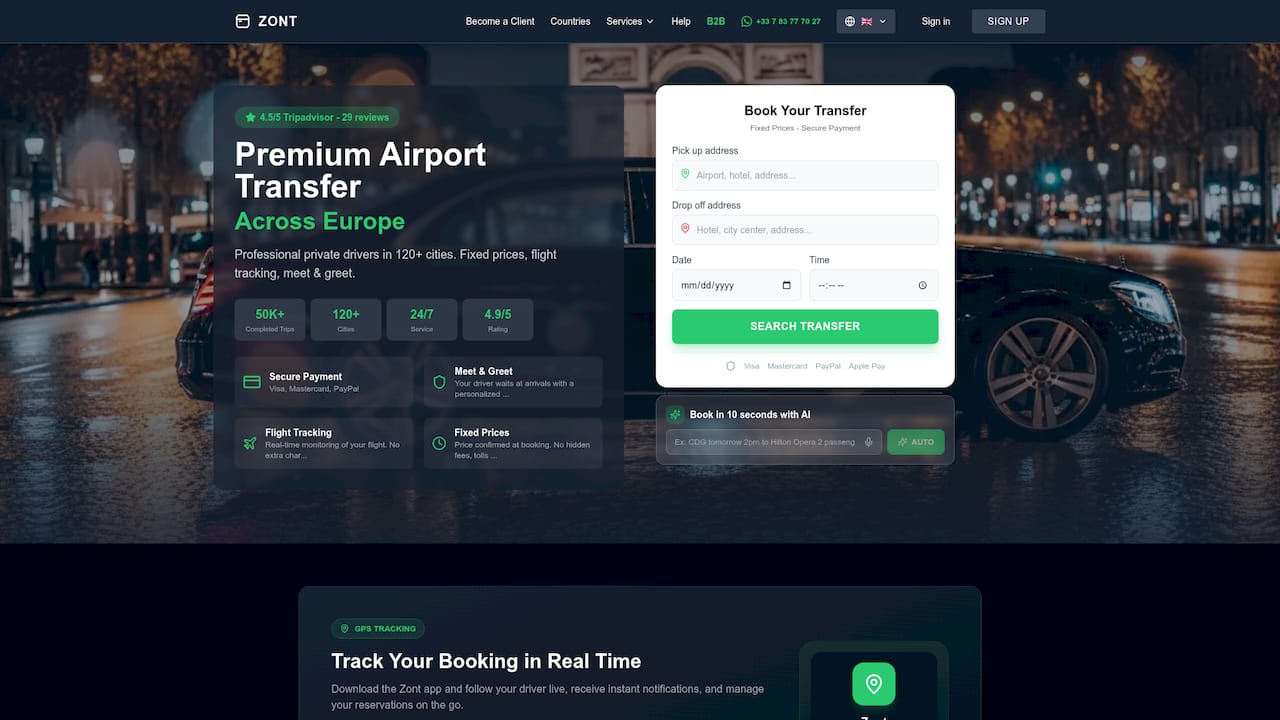
Zont Cab covers airport transfers across 120+ European cities, with premium vehicles including Mercedes sedans, BMWs, and family minivans. Every booking includes meet and greet, flight monitoring, and a fixed price confirmed before you travel. No surge pricing. No hidden fees. For business travelers, the concierge services tier adds multilingual support and itinerary coordination for multi-stop days.
If you are ready to book or want to check availability for your next trip, visit Zont Cab and get a fixed quote in under two minutes.
Useful sources
Licensing rules, insurance requirements, and professional standards for chauffeurs vary by state. The sources below are the most reliable starting points for verification.
- Bureau of Labor Statistics: Taxi Drivers and Chauffeurs — occupational overview, earnings, and job outlook
- BLS Occupational Employment Statistics: Taxi Drivers and Chauffeurs — wage data by state and metro area
- Federal Motor Carrier Safety Administration (FMCSA) — federal insurance minimums and safety regulations for commercial passenger carriers
- LegalClarity: How to Obtain a Chauffeur’s License — state-by-state endorsement requirements and application steps
- LegalClarity: How to Get a Chauffeur’s License — background check and knowledge test requirements
- learn.org: How Do I Become a Chauffeur? — training pathways and career entry points
- National Limousine Association (limo.org) — industry standards, operator certification, and regulatory updates
State DMV note: For-hire endorsement rules, renewal periods, and vehicle inspection requirements differ significantly by state. Check your state DMV’s commercial or for-hire driver licensing page for the exact requirements before booking or applying.