Airport Chauffeur Invoice: Your Complete U.S. Guide

No single federal law requires U.S. airport chauffeurs, taxis, or ride-hail drivers to hand you a formal invoice. What you get depends on the operator type, the city, and the airport. The good news: every major service type has a reliable path to a business-ready receipt, and most take under two minutes to secure. Here are three immediate actions to take right after any airport ride:
- For app rides (Uber, Lyft): Open the app within minutes of drop-off. The digital receipt lands in your email automatically and appears in your ride history. Download or forward it before you forget.
- Ask the driver directly: For metered taxis and private chauffeurs, request a printed or written receipt before you close the car door. Say: “Could I get a receipt, please?” or in French: “Puis-je avoir un reçu, s’il vous plaît ?”
- Record the basics yourself: If nothing else is available, note the date, time, pickup and drop-off addresses, total paid, and payment method. That minimum set satisfies most corporate expense systems in a pinch.
Key Takeaways
A business-ready airport chauffeur invoice requires the right fields, the right timing, and knowing which service type you booked.
| Point | Details |
|---|---|
| No federal invoice law | Requirements depend on operator type (taxi, app, private chauffeur) and local city or airport rules. |
| App receipts are automatic | Uber and Lyft email receipts instantly; download as PDF or use a business account for formal invoices. |
| Seven required fields | Date/time, route, itemized fare, airport surcharges, vendor identity, payment method, and receipt number. |
| Missing receipt process | Contact provider first, then platform support, then airport authority, then card issuer if unresolved. |
| Zont Cab for corporate billing | Zont Cab offers fixed pricing, itemized invoices, and corporate transfer services across 120+ European cities. |
Table of Contents
- How does receipt issuance differ by airport service type?
- Why local rules and airport policy matter
- What fields must a business-ready receipt include?
- How do invoices factor into U.S. expense reporting and IRS recordkeeping?
- How do you actually request a formal invoice?
- What to do when a receipt is missing or the fare looks wrong
- A copyable invoice template for airport transfers
- The habit that makes expense reporting painless
- Zont Cab: fixed pricing and formal invoices, built for business travelers
- Sources
How does receipt issuance differ by airport service type?
The three main service types at U.S. airports each handle billing differently, and knowing which one you booked changes where you look for your airport transfer receipt.
Metered taxis
Most regulated taxis at major U.S. airports are required by their municipal taxi commission to provide a printed receipt at the end of the ride. The taximeter prints a slip that includes the fare, date, and medallion or vehicle number. The level of detail varies by city: some cities mandate itemized breakdowns (base fare, tolls, airport surcharge, tip), while others print only a total. If the printer is broken or the driver skips it, ask explicitly before paying.
Ride-hail apps: Uber and Lyft
Uber and Lyft send an automatic email receipt the moment your ride ends. Both platforms also store receipts in your account history indefinitely, so you can retrieve one months later. For corporate expense rules, both platforms offer a business account option. Uber for Business and Lyft Business let you attach a company billing profile, generate itemized invoices, and export ride data directly to expense tools like Concur or Expensify. If you used a personal account, you can still download the in-app receipt as a PDF and submit it. The receipt includes fare, tolls, airport fees, and any tip paid through the app.
Platforms like Uber typically invoice the passenger directly and remit a net amount to the driver, which means the receipt you receive is a platform-issued document, not a driver-issued invoice. For most corporate expense teams, that distinction does not matter. For a formal supplier invoice with a company name and billing address, you need to contact platform support.
Private chauffeur and limousine companies

Private chauffeur companies are the most flexible for corporate billing. Most can issue a formal invoice on request, either at the time of booking or after the ride, by email. Corporate clients often receive itemized billing automatically as part of a standing account arrangement. The invoice typically includes the company’s name, address, booking reference, vehicle details, and a full line-item breakdown.
Pro Tip: When you need a formal corporate invoice, state this at the time of booking and save your booking confirmation number. A private chauffeur company can produce a properly formatted invoice far more readily than an app driver can, and having the reference on hand speeds up any billing request.
Why local rules and airport policy matter
There is no uniform federal invoice law for ground transportation in the United States. What exists instead is a patchwork of municipal taxi commission rules, state transport regulations, and airport-specific ground-transport policies.
- City taxi commissions set the rules for metered cabs, including whether drivers must issue receipts, what fare information must appear, and whether driver ID or license numbers are required on printed slips. New York City’s Taxi and Limousine Commission, for example, mandates itemized receipts for all credit card transactions.
- Airport ground-transport offices often impose additional requirements on all operators permitted to pick up at the airport, including fare schedule displays, permit numbers, and in some cases receipt formats.
- State regulations can layer on top of both, particularly for licensed limousine and transportation network companies.
To find the rules that apply to a specific airport, search “[airport name] ground transportation rules” or visit the airport’s official website and look for the ground transportation or taxi/rideshare section. For taxis specifically, the city’s taxi commission website is the authoritative source. When in doubt, contact the airport’s ground-transport authority directly before your trip.
For context, France takes a more prescriptive approach: French regulations require taxis to provide a receipt above a certain fare threshold and allow airports to publish fixed fares. The U.S. has no equivalent national standard, which is exactly why knowing your operator type and local rules matters.
What fields must a business-ready receipt include?
A receipt that satisfies both your finance team and IRS recordkeeping requirements for business travel needs specific information. The checklist below covers every field an accounting team is likely to ask for.
| Field | Why it matters |
|---|---|
| Date and time of service | Ties the expense to a specific business trip or meeting |
| Point of origin and destination | Confirms the ride was business-related and matches travel records |
| Fare breakdown (base fare, tolls, airport surcharge, gratuity) | Allows itemized reimbursement and separates non-reimbursable items |
| Payment method | Proof of payment; must match the card or account used |
| Total amount paid | Final figure for expense submission |
| Invoice or receipt number | Audit traceability; prevents duplicate submissions |
| Supplier identity (driver name or company name, address, contact email) | Identifies the vendor for accounts payable records |
| Booking reference (if applicable) | Links the receipt to a pre-booked reservation |
For corporate clients, add a cost-center reference or purchase order number if your company requires one. Airport surcharges and tolls should appear as separate line items, not bundled into the base fare. Finance teams and auditors look for that separation when reviewing travel claims.
According to the mandatory invoice fields outlined for VTC services, a proper chauffeur invoice must identify both the issuer and the client, carry a unique sequential invoice number, and detail each service line with the applicable rate. While that standard applies to French VTC operators, it maps directly onto what U.S. corporate expense teams expect.
Pro Tip: Keep both the in-app receipt and any emailed PDF invoice. If a key field is missing, contact the provider immediately and request a reissued document. Most platforms and chauffeur companies will correct an invoice within 24 hours when asked politely and with a booking reference in hand.
How do invoices factor into U.S. expense reporting and IRS recordkeeping?
The IRS requires business travelers to substantiate travel expenses with records that show the amount, time, place, and business purpose of each expense. A detailed receipt from an airport chauffeur or taxi satisfies that requirement when it includes the fields listed above.
- Finance team requirements: Most corporate expense policies require date, route, vendor name, total amount, and proof of payment. A receipt that shows all of these clears standard expense submission without additional documentation.
- Tips and tolls: Driver tips paid through an app are documented on the receipt and are generally reimbursable under most corporate travel policies, though some companies cap tip reimbursement. Tolls appear as a separate line item and are fully reimbursable as a business travel cost.
- Record retention: The IRS generally recommends keeping business expense records for at least three years from the date you file the return they support. Keep digital copies of all receipts in a dedicated folder, organized by trip date.
- Acceptable proof formats: Digital receipts (email PDFs, app screenshots) are fully acceptable to the IRS. You do not need a paper original.
Consult your company’s travel policy and IRS Publication 463 for the specific retention periods and documentation standards that apply to your situation.
How do you actually request a formal invoice?
The process differs slightly depending on when you ask and which service type you used.
- Before booking (private chauffeur or limo company): Include a note in the booking form or confirmation email: “Please issue a formal invoice to [Company Name], [billing address], attention [name].” For Uber for Business or Lyft Business, attach your company billing profile to the account before the ride.
- At the end of the ride (taxi): Before paying, say: “Can I get an itemized receipt?” or “Puis-je avoir un reçu détaillé ?” For credit card payments, the terminal usually prints one automatically.
- After an app ride: Open Uber or Lyft, go to your ride history, select the trip, and download the receipt as a PDF. For a formal invoice with company details, contact the platform’s help center with your trip ID and billing information.
- After a private chauffeur ride: Email the company’s billing department with your booking reference, ride date and time, and the invoice fields you need. A sample request: “Dear [Company], please issue a formal invoice for booking [reference] on [date], addressed to [Company Name, address]. Required fields: invoice number, itemized fare, payment method, and your company details.”
- If you lost the receipt: Contact the provider’s support channel within 48 hours. Most platforms and chauffeur companies can reissue receipts for up to 12 months after the ride.
Pro Tip: Photograph the driver’s permit card or business card and the vehicle license plate at the start of every ride. That two-second habit gives you a fallback identifier if the receipt goes missing or contains an error.
For more on pre-booking practices that protect your documentation trail, the best practices for booking airport rides guide covers confirmation workflows worth adopting.
What to do when a receipt is missing or the fare looks wrong
Missing or incorrect receipts are more common than they should be. Work through this sequence before escalating.
- Step 1 — Gather your evidence: Note the exact time, pickup and drop-off addresses, payment method, and any booking ID or app trip reference. Screenshot the payment confirmation from your bank or card app.
- Step 2 — Contact the driver or company directly: For private chauffeurs and taxis, call or email the company with your booking reference and request a corrected invoice. Most issues resolve here.
- Step 3 — Use the platform’s dispute process: Uber and Lyft both have in-app fare review tools. Select the trip, tap “Help,” and submit a fare dispute or receipt request. Both platforms typically respond within 24–48 hours.
- Step 4 — Escalate to the airport or city authority: For taxis, the city taxi commission or airport ground-transport office can intervene when a driver refuses to provide a receipt or the fare appears to violate regulated rates.
- Step 5 — Request a card chargeback: If you paid by credit or debit card and the provider has not resolved the issue after exhausting the steps above, contact your card issuer to dispute the charge. Keep all correspondence as supporting documentation.
Avoiding these situations starts with booking habits. The common airport taxi mistakes travelers make covers the scenarios that most often lead to receipt problems.
A copyable invoice template for airport transfers
Use this template when requesting a formal invoice from a private chauffeur or limo company, or when asking a provider to reissue a corrected document.
Invoice template fields:
- Invoice number (sequential, e.g., INV-2026-0047)
- Issue date
- Service date and time
- Supplier name, address, and billing email
- Vehicle type and license plate
- Pickup address (including terminal if airport)
- Drop-off address
- Line items: base fare / distance or time charge / airport surcharge / tolls / gratuity
- Payment method (card type and last four digits, or cash)
- Total amount paid
- Booking reference number
- Client name and billing address (or company name and cost-center code)
Filled example:
The Kelyseo guide to VTC invoice requirements notes that passenger transport invoices must carry a sequential invoice number and itemized line items, a standard that translates directly to U.S.
For comparison, French VTC operators work under a structured framework where VAT thresholds and franchise rules determine whether a driver must collect VAT at all. In the U.S., sales tax on transportation services varies by state and is generally not charged by ride-hail platforms, so the invoice fields that matter most are the fare breakdown and vendor identity rather than a tax rate line.
The habit that makes expense reporting painless
Business travelers who never stress about receipts share one trait: they treat documentation as part of the ride, not an afterthought.
Book a private chauffeur for an early-morning airport pickup and you have a clean window to get everything right. Request the invoice format at booking, confirm the billing email, and save the confirmation to a dedicated “Travel Receipts” folder in your email. When the driver arrives, take a quick photo of the vehicle plate. After drop-off, forward the emailed invoice to your expense system before you reach the gate. The whole process takes under three minutes and eliminates every follow-up email your finance team would otherwise send.
The same folder discipline works for app rides: forward every Uber or Lyft receipt to your expense email the moment it arrives. A month-end expense review that used to take an hour drops to fifteen minutes when every receipt is already in one place. Photograph driver ID cards for taxi rides where the printed receipt is thin on vendor details. These small habits compound fast.
Zont Cab: fixed pricing and formal invoices, built for business travelers
If you have spent time chasing a missing receipt from an app or waiting on a taxi company’s billing department, the appeal of a pre-booked service with transparent documentation is obvious.
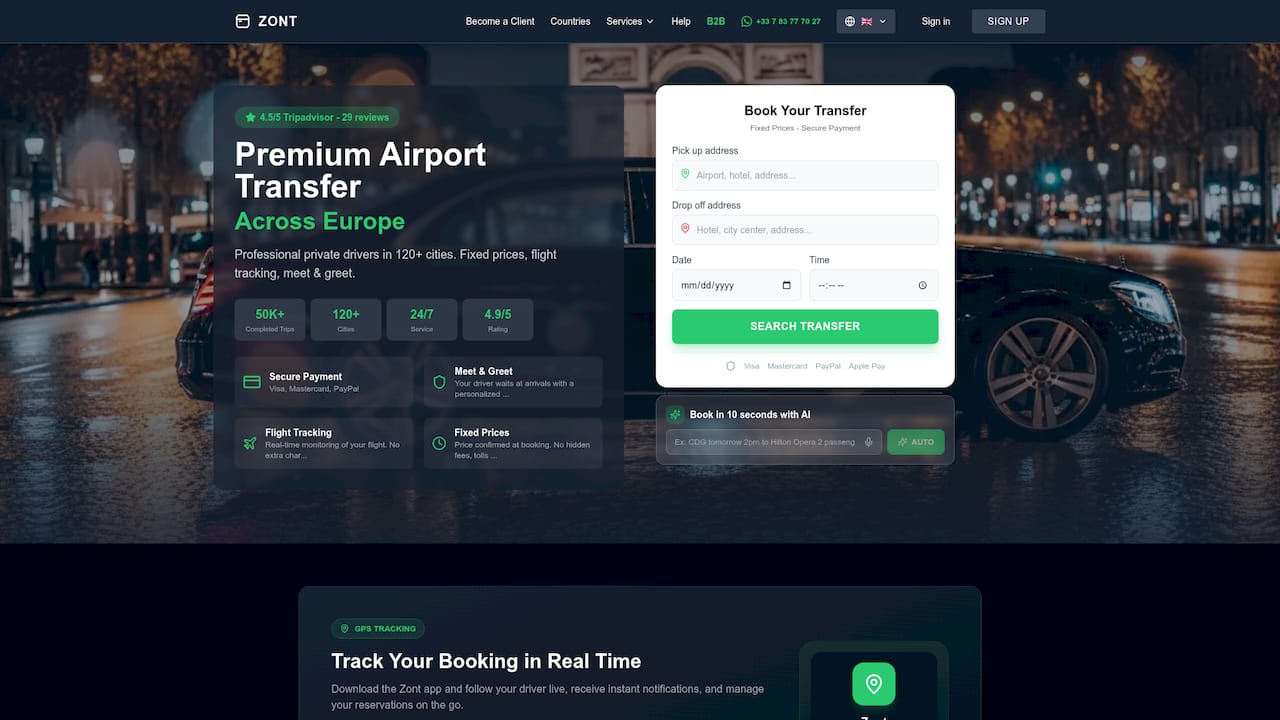
Zont Cab offers fixed-price airport transfers across 120+ cities in Europe, with no hidden fees and a formal invoice issued for every booking. Corporate clients get itemized billing, a dedicated account manager, and receipts that arrive by email before the ride ends. Flight tracking means the driver adjusts to delays automatically, so you are not paying a waiting-time surcharge because your flight landed late. For business travelers who need clean documentation for expense reporting, that fixed-price, pre-invoiced model removes the variables that create receipt problems in the first place. Explore Zont Cab’s corporate transfer services and book your next airport transfer with billing sorted from the start.
This article is general information, not a substitute for advice from a qualified financial advisor. Consult a qualified financial professional about your own circumstances before acting on anything here.