Flight Tracking Airport Transfer Explained for Travelers

Flight tracking airport transfer, known in the industry as flight-monitored ground transport, is the process where a transfer service monitors your flight’s real-time status and adjusts your driver’s arrival time to match your actual landing. Most travelers assume their driver simply shows up at the scheduled time. That assumption causes missed pickups, unnecessary waiting fees, and real stress. Zont Cab has completed over 50,000 trips across more than 120 European cities by doing the opposite: syncing every pickup to live aviation data so the car arrives when you do, not when the airline hoped you would.
How does flight tracking work in airport transfers?
Flight tracking in professional airport transfers starts with one piece of data: your flight number. That number acts as a unique identifier that connects your booking to a live aviation data feed. Dispatch systems use flight numbers as primary keys to trigger driver routing automatically, which means no human needs to manually check your flight status every hour.
The data feeding these systems comes from three main sources. ADS-B signals are radio transmissions from aircraft transponders that reveal a plane’s position, altitude, and speed in real time. Airport FIDS (Flight Information Display Systems) provide gate and terminal data directly from airport operators. Airline operational systems supply the official status fields, including “Scheduled,” “Delayed,” “Landed,” and “Arrival.” Together, these sources give dispatch engines a complete picture of where your flight is and when it will actually touch down.

Professional systems poll aviation APIs every 1–5 minutes and adjust driver schedules when a flight is delayed beyond 15 minutes or arrives more than 10 minutes early. That polling frequency matters because a flight can shift from “on time” to “delayed 45 minutes” in a single update cycle. Without that constant check, a driver could be sitting in a parking structure for an hour, racking up fees, while you are still over the Atlantic.
The dispatch engine uses state machine logic. It holds the driver in a standby state until the flight status changes to “Landed” or “Arrival,” then triggers the routing command. This state machine approach prevents costly early arrivals and driver idle time. Think of it as a traffic light that only turns green when your wheels are on the ground.
| Data source | What it provides | Update frequency |
|---|---|---|
| ADS-B signals | Aircraft position, speed, altitude | Continuous |
| Airport FIDS | Gate assignments, terminal data | Every few minutes |
| Airline operational systems | Official status fields (Delayed, Landed) | Real-time push |
| Aviation data APIs | Aggregated, normalized flight data | Every 1–5 minutes |
Pro Tip: Always give your transfer provider your flight number at booking, not just the scheduled arrival time. Without an accurate flight number, automated tracking fails entirely and your booking becomes an orphaned reservation with no live data attached.
What are the real benefits of flight-tracked airport pickups?
Flight tracking removes the single biggest variable in airport transfers: uncertainty. When a driver knows your flight landed 22 minutes late, they adjust. When a driver only knows your scheduled arrival time, they either wait too long or arrive too early. Both outcomes cost you money and time.
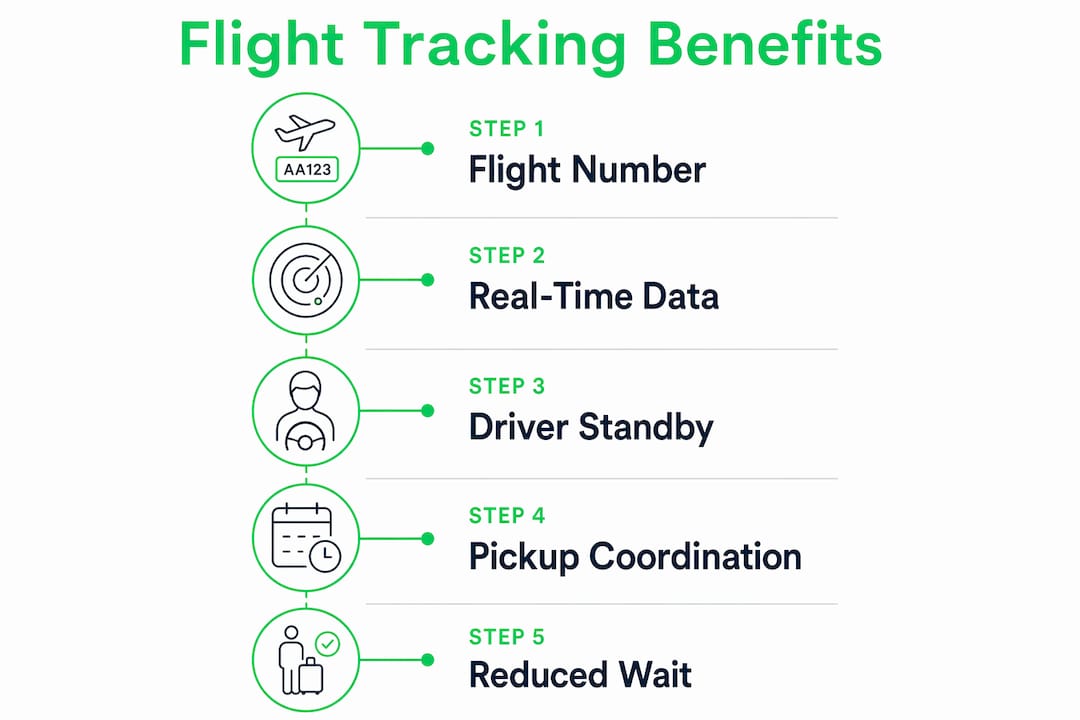
Drivers at airports face strict parking limits and rules, so flight tracking lets services reduce excessive waiting and avoid fines. Those savings translate directly to fare stability for you. A service that tracks flights does not need to pad its pricing to cover unpredictable parking costs.
The benefits for travelers are concrete and measurable:
- No waiting fees. Your driver arrives after your flight lands, not before, so you are not charged for time spent in baggage claim.
- Reliability on delayed flights. A two-hour delay does not mean a missed pickup. The driver’s schedule shifts automatically.
- Early arrival coverage. If your flight lands 20 minutes ahead of schedule, a good tracking system catches that and moves the driver up.
- Fare stability. Fixed pricing combined with flight tracking means no surge charges because your flight was late.
- Reduced stress. You exit the terminal knowing your car is already adjusted to your actual landing time.
Flight tracking reduces driver waiting fees and improves transport efficiency by coordinating dispatch when flight status shifts from “Scheduled” to “Arrival.” That efficiency is not just operational. It means you spend less time standing at the curb and more time moving toward your destination.
One detail most travelers miss: scheduled arrival time is not the same as pickup readiness. Baggage claim, immigration delays, and terminal transfers all add time between landing and reaching the curb. A well-calibrated transfer service accounts for this buffer, not just the wheels-down moment.
How can you track your own flight effectively?
Travelers who monitor their own flights arrive better prepared and communicate more effectively with their transfer providers. The standard tools for real-time flight updates include airline apps, FlightAware, and FlightRadar24. Each pulls from different data sources, which means they sometimes disagree on status or timing.
Cross-verifying flight status across multiple apps significantly improves accuracy and reduces unnecessary wait time and costs. If your airline app says “on time” but FlightAware shows a 30-minute delay, the discrepancy is worth a quick check before you assume everything is fine. Airline apps often lag behind third-party trackers because they display the airline’s official position, not the live radar data.
Here are the most effective practices for tracking your flight as a traveler:
- Enable push notifications from your airline app before departure. These are the fastest official updates.
- Cross-check with FlightAware or FlightRadar24 for radar-based position data, especially on international routes.
- Share your flight number proactively with your transfer provider at booking and again if the number changes due to a rebooking.
- Check the departure airport’s FIDS if you are connecting through a hub. Gate changes affect your connection time and your transfer timing.
- Contact your driver or transfer service if your flight status changes significantly, even if the service tracks flights automatically. Human confirmation adds a layer of reliability.
Pro Tip: If you get rebooked onto a different flight, update your transfer provider immediately. Without an accurate flight number, automated tracking protocols fail completely, causing orphaned bookings and unnecessary driver dispatches.
Which airport transfer option handles flight tracking best?
Not all transfer options integrate flight tracking, and that gap in service quality shows up most clearly when your flight does not land on time. Understanding what each option offers helps you choose based on your actual needs, not just price.
Prebooked private transfers with flight tracking represent the most reliable option for arrivals where timing matters. Private transfers with flight tracking are recommended for arrivals prioritizing reliability and luggage handling, avoiding surge pricing and uncertain wait times from rideshares. That recommendation holds especially for late-night arrivals, international flights with immigration queues, and trips with multiple bags.
Standard taxis and rideshare apps do not track your flight. They respond to your request after you land, clear customs, and open the app. If demand is high at that moment, you pay surge pricing. If the queue is long, you wait. Neither outcome is predictable.
| Transfer type | Flight tracking | Fare stability | Luggage handling | Wait time risk |
|---|---|---|---|---|
| Prebooked private transfer | Yes | Fixed price | Included | Very low |
| Standard taxi | No | Metered | Self-managed | Moderate |
| Rideshare app | No | Surge pricing possible | Self-managed | High at peak times |
| Airport shuttle | No | Fixed but shared | Limited | High (shared schedule) |
Professional transfer providers coordinate terminal assistance, including Meet & Greet services, to deliver door-to-door transfers integrated with flight tracking. That means a driver holding a name sign at arrivals, not a car circling the pickup loop hoping you appear.
When a tracked private transfer is worth the premium:
- You are traveling with children, elderly passengers, or oversized luggage.
- Your flight arrives after midnight when rideshare availability drops.
- You are connecting to a meeting or event where a late arrival has real consequences.
- You are traveling to a city you do not know well and cannot afford navigation confusion.
For budget-conscious travelers on short domestic hops with carry-on luggage only, a rideshare or shuttle may be sufficient. For everything else, booking airport rides in advance with a tracked private service is the more reliable choice.
Key Takeaways
Flight-tracked airport transfers eliminate pickup uncertainty by syncing driver dispatch directly to your flight’s live status, not its scheduled arrival time.
| Point | Details |
|---|---|
| Flight number is critical | Without your flight number, automated tracking fails and your booking loses its live data connection. |
| Systems poll every 1–5 minutes | Dispatch engines adjust driver timing for delays over 15 minutes or early arrivals over 10 minutes. |
| Scheduled time is not pickup time | Baggage claim and immigration add significant time between landing and reaching the curb. |
| Cross-verify flight status | Using multiple tracking apps improves accuracy and reduces unnecessary wait time. |
| Private transfers outperform alternatives | Prebooked tracked transfers offer fixed pricing, luggage handling, and reliable pickups that rideshares cannot match. |
What I have learned from years of watching airport pickups go wrong
The most common failure I see is not a technology problem. It is a communication problem. A traveler gets rebooked at the gate, lands on a different flight number, and never updates their transfer provider. The original driver waits at arrivals for a passenger who is already in a taxi. The tracking system worked perfectly. It tracked the wrong flight.
The second most common failure is overconfidence in a single data source. Travelers who rely only on their airline app sometimes miss a delay that third-party radar data caught 20 minutes earlier. That 20-minute gap is the difference between a driver who adjusts and a driver who is already parked and waiting.
What I find genuinely underappreciated is how much airport parking rules shape the quality of your pickup. Drivers face strict parking limits at most major airports, so a service that cannot track flights is forced to either arrive late or absorb fines. Neither outcome serves you. Flight tracking is not a luxury feature. It is the operational foundation that makes a fixed-price transfer actually work.
My honest advice: treat your flight number like a confirmation code. Guard it, share it with your transfer provider, and update it the moment anything changes. The technology behind modern airport transfer tracking is genuinely impressive. But it only works when it has accurate data to work with.
— Arthur
Zont Cab’s approach to flight-tracked transfers across Europe
Zont Cab builds live flight tracking into every airport pickup across its network of over 120 European cities. The system monitors your flight in real time and adjusts your driver’s schedule automatically, so you never land to an empty curb or a driver who has been waiting an hour.
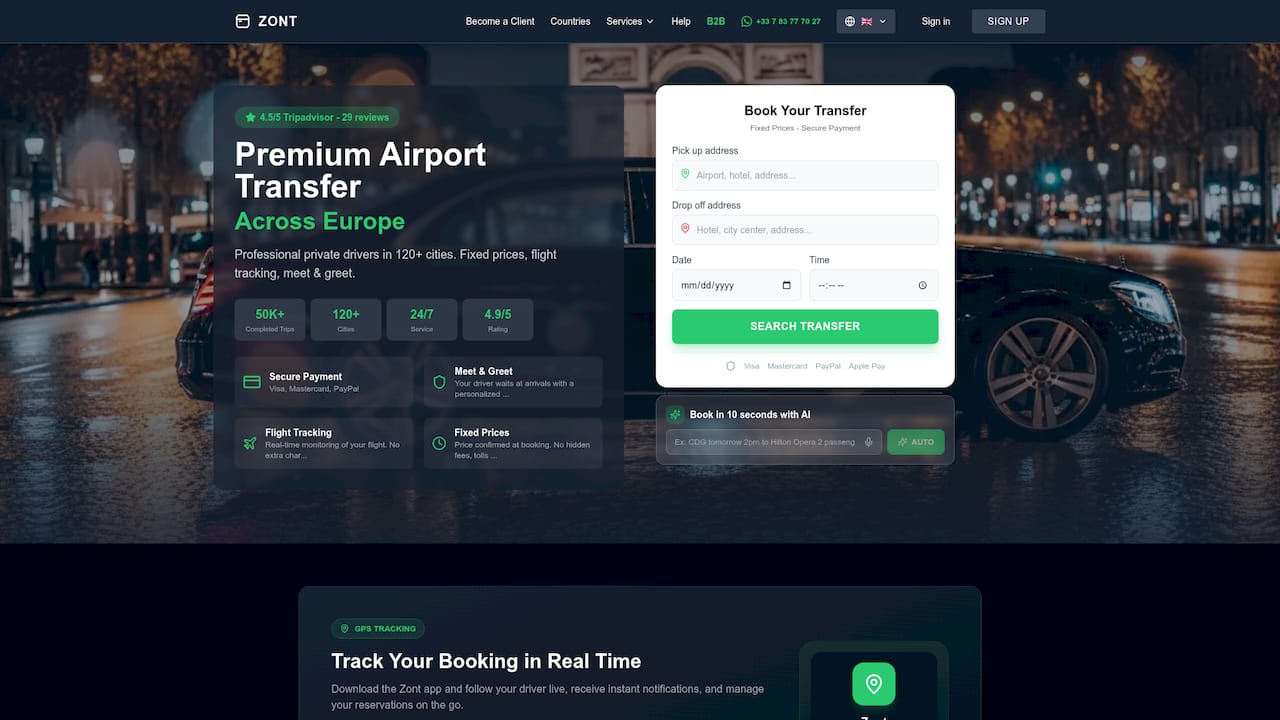
Every Zont Cab booking includes a professional driver, full luggage handling support, and a Meet & Greet service at arrivals. Pricing is fixed at booking with no hidden fees, regardless of how your flight status changes. Zont Cab holds a 4.5-star rating from verified TripAdvisor reviews, built on over 50,000 completed trips. Browse airport transfers across Europe and book in advance to lock in your rate and activate flight tracking for your pickup.
FAQ
What is flight tracking in airport transfers?
Flight tracking in airport transfers is the process where a transfer service monitors your flight’s real-time status using your flight number and aviation data APIs. The system adjusts your driver’s arrival time automatically based on actual landing data, not the scheduled time.
Why does my flight number matter for airport transfers?
Your flight number is the unique identifier that connects your booking to live aviation data. Without it, automated tracking fails and your driver receives no real-time updates about delays or early arrivals.
How do transfer services handle delayed flights?
Professional systems poll aviation data every 1–5 minutes and push driver schedule adjustments when a delay exceeds 15 minutes. The driver holds in standby until the flight status changes to “Landed,” then routes to the terminal.
Is a prebooked private transfer better than a rideshare for airport pickups?
Yes, for most international or late-night arrivals. Private transfers with flight tracking offer fixed pricing, luggage handling, and reliable timing that rideshare apps cannot provide, especially when flights are delayed.
What should I do if my flight number changes before travel?
Update your transfer provider immediately with the new flight number. Automated tracking protocols are tied to the original flight number, and a rebooking without notification creates an orphaned booking with no live data connection.