Why Early Flight Arrivals Complicate Transfers

Early flight arrivals complicate transfers because landing early does not mean passengers are ready for pickup. Airport ground operations run on scheduled times, not actual arrival times, so the gap between touchdown and the curb is almost always longer than travelers expect. Standard transfer protocols recommend waiting 25–40 minutes after landing for domestic flights and 45–90 minutes for international arrivals to account for taxiing, immigration, baggage claim, and customs. Understanding why early flight arrivals complicate transfers is the first step toward planning a pickup that actually works.
Why early flight arrivals complicate transfers more than delays do
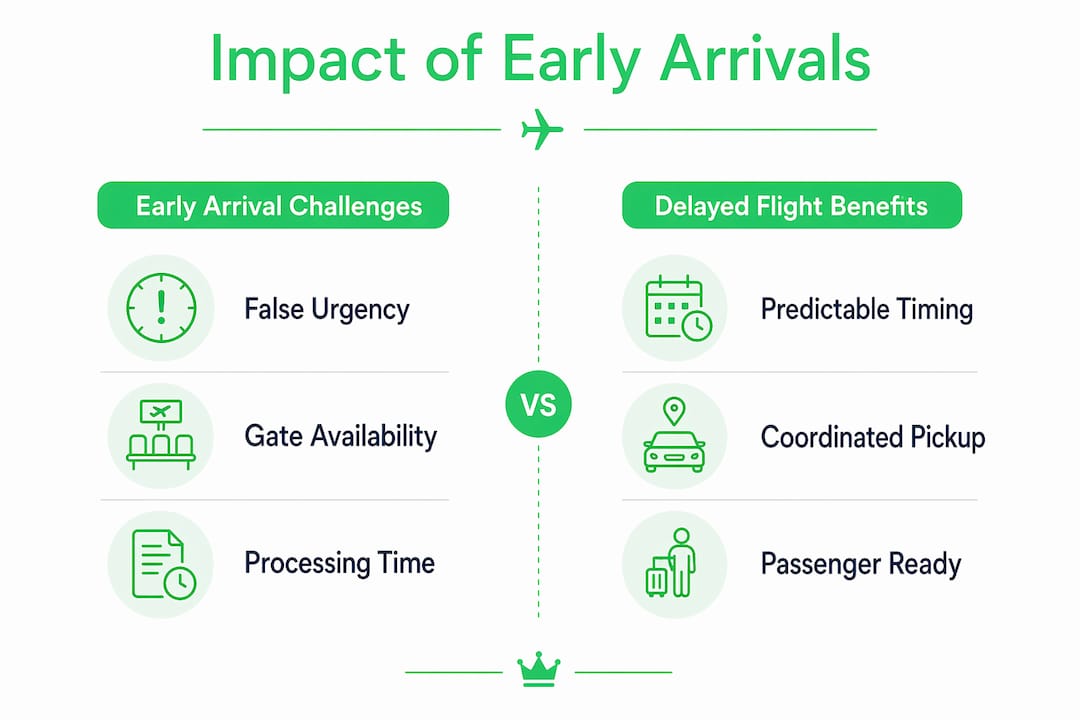
A delayed flight is predictable. Everyone adjusts. An early arrival creates the opposite problem: a false sense of urgency that catches both travelers and drivers off guard. A flight landing 30 minutes early may still deliver passengers to the curb at the originally scheduled time. That gap exists because terminal operations, gate assignments, and ground crew schedules are built around published timetables, not actual touchdown times.
Strong tailwinds are the most common culprit. Jetstream conditions can push a flight 75 minutes ahead of schedule, which sounds like a gift until you realize your driver is not there, your hotel room is not ready, and the tour you booked starts at the time you were originally supposed to land. Early arrivals shift the timing of everything downstream without giving any of those systems time to adjust.

The industry term for the full process between touchdown and passenger readiness is “post-landing processing time.” This covers taxiing to the gate, deplaning, walking to immigration or baggage claim, and clearing customs. Each step adds minutes that most travelers do not budget for when they see an early arrival notification on their phone.
What airport operations actually delay passenger readiness?
The gap between landing and pickup readiness is not random. It follows a predictable sequence of airport processes, each with its own variable timing.
- Taxiing to the gate: Aircraft often land on a runway far from the assigned gate. Taxiing alone can take 10–20 minutes at large hubs like Frankfurt, Charles de Gaulle, or Heathrow. If the gate is occupied because the previous flight has not pushed back yet, the plane holds on the tarmac.
- Deplaning: Passengers in the rear of a wide-body aircraft can wait 15 minutes or more before they reach the jet bridge. Add a restroom stop and that number climbs.
- Immigration and passport control: International travelers face queues that vary by terminal staffing, time of day, and the number of flights landing simultaneously. A 20-minute wait is optimistic at peak hours.
- Baggage claim: Baggage retrieval takes 10–30 minutes under normal conditions. At busy international hubs during peak travel periods, that window extends further. Checked bags are loaded onto carousels based on ground crew availability, not passenger urgency.
- Customs clearance: Travelers carrying goods to declare or flagged for secondary screening add another unpredictable block of time before they reach the arrivals hall.
Pro Tip: Share your flight number with your transfer provider before you board. A good service tracks your actual gate assignment and baggage carousel, not just your scheduled arrival time.
Gate availability is one of the least-discussed constraints. When a flight arrives early, its assigned gate may still be occupied. Ground operations cannot simply reassign a gate on the spot. The result is a plane sitting on the tarmac while passengers watch the minutes tick by, convinced they are about to walk out into the arrivals hall.
How do early arrivals impact transfer scheduling and logistics?
The operational impact of early arrivals on transfer services is significant. Ground transport providers that rely on static schedules, meaning they dispatch a driver based on the published arrival time, face two bad outcomes: the driver arrives too early and sits at the curb, or the driver arrives late because the flight landed ahead of schedule and the system did not update in time.
Curbside restrictions at major European airports are strict. Drivers cannot idle at the pickup zone indefinitely. Professional drivers stage vehicles off-site and move to the terminal only when passengers confirm they are ready. This practice avoids fines and curbside violations, but it requires real-time communication between the driver and the passenger.
The numbers behind flight schedule volatility make this problem concrete. Flight execution rates of 71.2% and departure delay rates of 10.1% mean that a significant share of flights do not operate exactly as scheduled. That level of variability makes static dispatch planning unreliable. Transfer services that do not use live flight data APIs are essentially guessing.
| Scenario | Static schedule result | Real-time tracking result |
|---|---|---|
| Flight arrives 30 min early | Driver waits at curb, risks fine | Driver adjusts dispatch, arrives on time |
| Flight arrives on schedule | Driver arrives correctly | No change needed |
| Flight arrives 45 min late | Passenger waits, driver idles | Driver delays dispatch, reduces idle time |
| Gate change after landing | Driver goes to wrong terminal | Driver receives updated gate, adjusts route |
Professional car services track estimated time of arrival, landing status, taxi-in progress, and gate assignment in real time to adjust driver dispatch dynamically. This reduces idle time and prevents the failed pickup scenarios that frustrate travelers.
Pro Tip: When booking a transfer, ask specifically whether the service uses live flight tracking APIs. A yes means your driver adjusts automatically. A no means you are responsible for calling when you land.
What traveler assumptions make early arrival problems worse?
Travelers create their own complications when they misread what an early arrival actually means. These are the most common mistakes.
- Assuming immediate pickup is possible. Seeing “landed” on a flight tracker does not mean you are at the curb. Post-landing processing time for an international flight averages 45–90 minutes. Expecting a driver to be waiting the moment you touch down sets up a frustrating experience for everyone.
- Booking rides based on scheduled times. Booking without sharing a flight number means the transfer service has no way to track your actual arrival. If your flight lands early, the driver dispatches at the original time and you wait.
- Ignoring baggage and customs time. Travelers who check bags routinely underestimate how long baggage claim takes. A 15-minute taxi ride to the hotel does not start the moment the wheels touch down. It starts when you clear customs with your luggage.
- Treating early arrival as extra time. A flight arriving 45 minutes early does not give you 45 extra minutes before your hotel check-in or your next connection. Hotels operate on published schedules. Check-in times, tour departures, and cruise boarding all run on the clock, not on your actual landing time.
- Skipping communication with the driver. Many travelers assume the transfer service will figure it out. The best outcome happens when you send a quick message after collecting your bags, confirming your location and readiness. That single action eliminates most pickup failures.
How can travelers and transfer services handle early arrivals well?
Coordination between travelers and transfer providers is the practical solution to early arrival complications. These steps make the difference between a smooth pickup and a stressful one.
-
Share your flight number at booking. This single action gives a professional transfer service everything it needs to track your actual arrival, gate assignment, and baggage carousel. The benefits of real-time flight tracking extend to every stage of the pickup process, from dispatch timing to driver positioning.
-
Build in buffer time for post-landing processing. For domestic arrivals, plan for at least 25–40 minutes between landing and pickup. For international flights, budget 45–90 minutes. Do not schedule onward connections or meetings based on your scheduled landing time alone.
-
Communicate after you collect your bags. Send a message to your driver or transfer service once you have your luggage and are heading to the arrivals hall. This is the moment the driver needs to know, not when the plane lands.
-
Understand staging and wait time policies. Ask your transfer provider how long they will wait after the agreed pickup time and whether they monitor your flight for changes. A service with a clear wait time policy and live tracking removes the guesswork entirely.
-
Manage your luggage efficiently. Packing carry-on only eliminates baggage claim entirely and cuts your post-landing processing time dramatically. When checked bags are unavoidable, luggage handling tips like using distinctive bag tags and tracking devices speed up carousel retrieval.
-
Choose a transfer service with dynamic scheduling. Static dispatch services cannot adapt to early arrivals. A provider that uses live flight data adjusts driver timing automatically, so you are never waiting at the curb and the driver is never circling the terminal.
Key Takeaways
Early flight arrivals complicate transfers because airport ground operations, gate availability, and passenger processing all run on scheduled times, not actual landing times.
| Point | Details |
|---|---|
| Landing early ≠ ready early | Post-landing processing takes 25–90 minutes depending on flight type and airport. |
| Static schedules fail travelers | Transfer services without live flight data cannot adapt to early or late arrivals. |
| Baggage claim is unpredictable | Retrieval takes 10–30 minutes and extends further at busy international hubs. |
| Share your flight number | Giving your transfer provider a flight number enables real-time dispatch adjustments. |
| Buffer time is non-negotiable | Build 25–40 minutes for domestic and 45–90 minutes for international arrivals into every transfer plan. |
The false urgency problem nobody talks about
Early arrivals create a specific kind of stress that delayed flights do not. When a flight lands late, everyone expects to wait. When a flight lands early, travelers feel a sudden pressure to move fast, as if they are behind schedule on a schedule that does not actually exist yet.
I have watched this play out dozens of times. A traveler lands 40 minutes early, sends a panicked message to their driver, and then spends 35 of those 40 minutes standing at baggage claim. The urgency was entirely manufactured. The airport did not speed up to match the early landing. The baggage carousel ran on its own schedule. The customs queue had no idea the flight arrived ahead of time.
The real lesson is that early arrivals require patience, not speed. The traveler who lands early and immediately relaxes, knowing their driver is tracking the flight and will be there when the bags arrive, has a far better experience than the one frantically texting from the tarmac. Ground operations are not instantly adaptable. Accepting that fact removes most of the stress.
Choosing a transfer service that uses live flight monitoring is the single most effective decision a traveler can make. It removes the coordination burden entirely. You focus on getting through the terminal. The driver handles the timing. That division of responsibility is what makes a transfer feel effortless rather than stressful.
— Arthur
Zont Cab takes the guesswork out of early arrivals
Early arrivals are where most transfer services fall short. Zont Cab is built specifically for this problem.
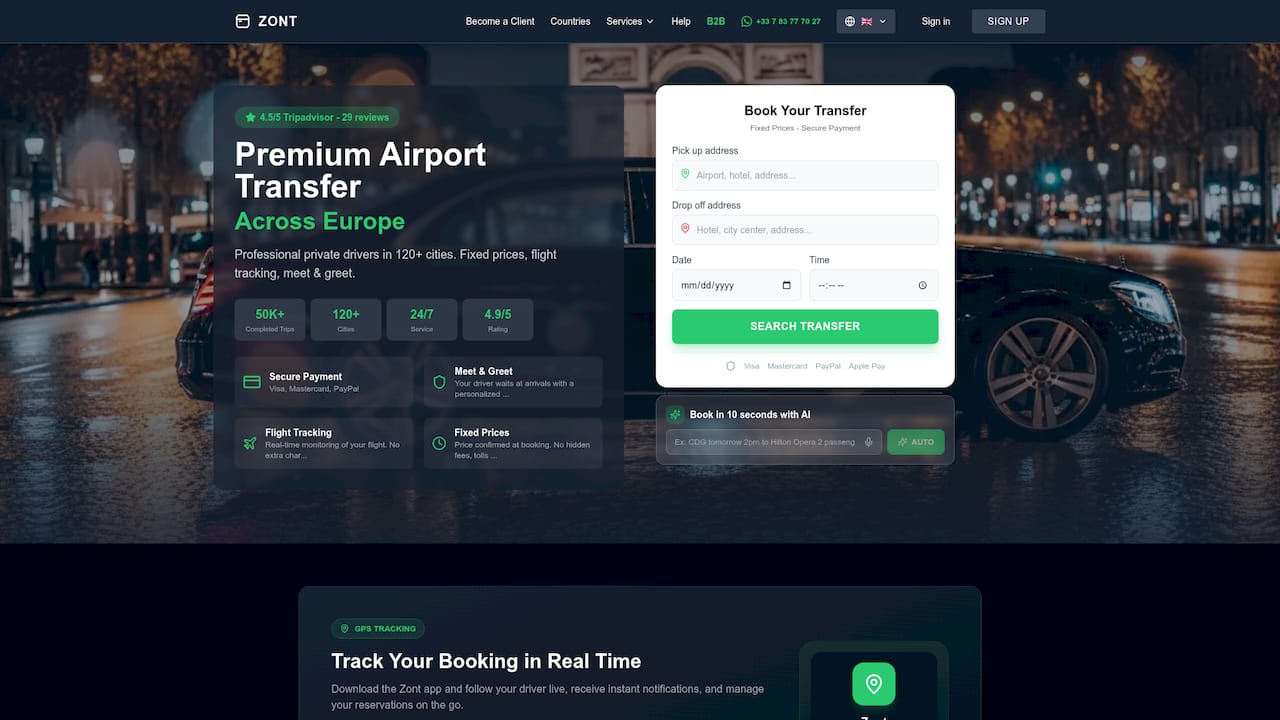
Zont Cab integrates live flight tracking into every booking across more than 120 cities in Europe. When your flight lands early, the system adjusts driver dispatch automatically based on your actual gate assignment and estimated baggage claim time. Built-in wait buffers for both domestic and international arrivals mean your driver is positioned correctly whether you land on time, early, or late. Fixed pricing with no hidden fees applies regardless of schedule changes. With over 50,000 completed trips and a 4.5-star TripAdvisor rating, Zont Cab delivers the punctuality and professionalism that early arrivals demand.
FAQ
Why does an early landing not mean an early pickup?
Airport operations run on scheduled times, not actual arrival times. Gate availability, ground crew scheduling, and baggage carousel assignments do not adjust automatically when a flight lands early, so post-landing processing still takes 25–90 minutes.
How long should I wait before contacting my driver after landing?
Contact your driver after you have collected your bags and are walking toward the arrivals hall. For international flights, that typically means 45–90 minutes after landing; for domestic flights, 25–40 minutes is a reasonable baseline.
What is driver staging and why does it matter?
Driver staging means the driver waits off-site rather than at the curbside pickup zone. Professional services use staging to avoid curbside fines and restrictions, moving to the terminal only when the passenger confirms readiness.
Does sharing my flight number actually help?
Sharing your flight number gives the transfer service real-time access to your gate assignment, landing status, and taxi-in progress. Without a flight number, the service dispatches based on your scheduled arrival time and cannot adapt to early or late changes.
Can early arrivals disrupt hotel check-in or tour schedules?
Early arrivals do not accelerate hotel check-in times or tour departures, which operate on fixed published schedules. Arriving 45 minutes early at the airport does not translate to checking in 45 minutes earlier at your hotel.