European Transfer Regulations: What US Travelers Must Know

When you book a private airport or chauffeur transfer in Europe, three EU legal frameworks shape what you can expect: Directive (EU) 2022/2561 on driver qualification, Regulation (EC) No 1071/2009 on operator standards, and Directive 2015/2302 on package travel rights. Before you confirm any booking, run through these three checks:
- Driver credentials: Does the driver hold a CPC (Certificate of Professional Competence) or code ‘95’ on their license?
- Operator registration: Is the company a licensed road transport operator under Regulation 1071/2009, with a designated transport manager?
- Booking classification: Is your transfer sold as part of a package holiday, a linked travel arrangement (LTA), or a standalone service? The answer changes your refund and compensation rights.
At the booking stage, also ask:
- Does the price include flight tracking and free waiting time for delays?
- Is 24/7 customer support available?
- What insolvency protection or payment security covers your booking?
- Are pricing and cancellation terms stated upfront, with no hidden fees?
Key Takeaways
EU driver qualification rules, operator licensing standards, and package-travel protections together define what you should expect from any private airport transfer in Europe, and knowing which category your booking falls into determines your remedies if something fails.
| Point | Details |
|---|---|
| Check CPC/code ‘95’ | Drivers must complete initial qualification and 35 hours of periodic training every five years. |
| Verify operator credentials | Licensed operators under Regulation 1071/2009 must meet good repute, financial standing, and professional competence standards. |
| Know your booking type | Package bookings carry the strongest protections; standalone transfers rely on the supplier’s own terms. |
| Insist on flight tracking and 24/7 support | These features protect you when flights are delayed and problems arise outside business hours. |
| Zont Cab | Covers 120+ European cities with fixed pricing, flight tracking, and 24/7 support across 50,000+ completed trips. |
Table of Contents
- How European transfer regulations work: the core legal framework
- Is your transfer a package, an LTA, or just a standalone booking?
- What safety and compliance signals should you look for?
- What rights and remedies do you have if something goes wrong?
- Your booking checklist for private transfers in Europe
- What to do immediately if a transfer fails
- Why Zont Cab is built around these exact standards
- A note from Arthur on what actually goes wrong at European airports
- Sources
How European transfer regulations work: the core legal framework
Two EU instruments set the baseline for every professional driver and operator you’ll encounter on a private transfer.
Driver qualification under Directive (EU) 2022/2561
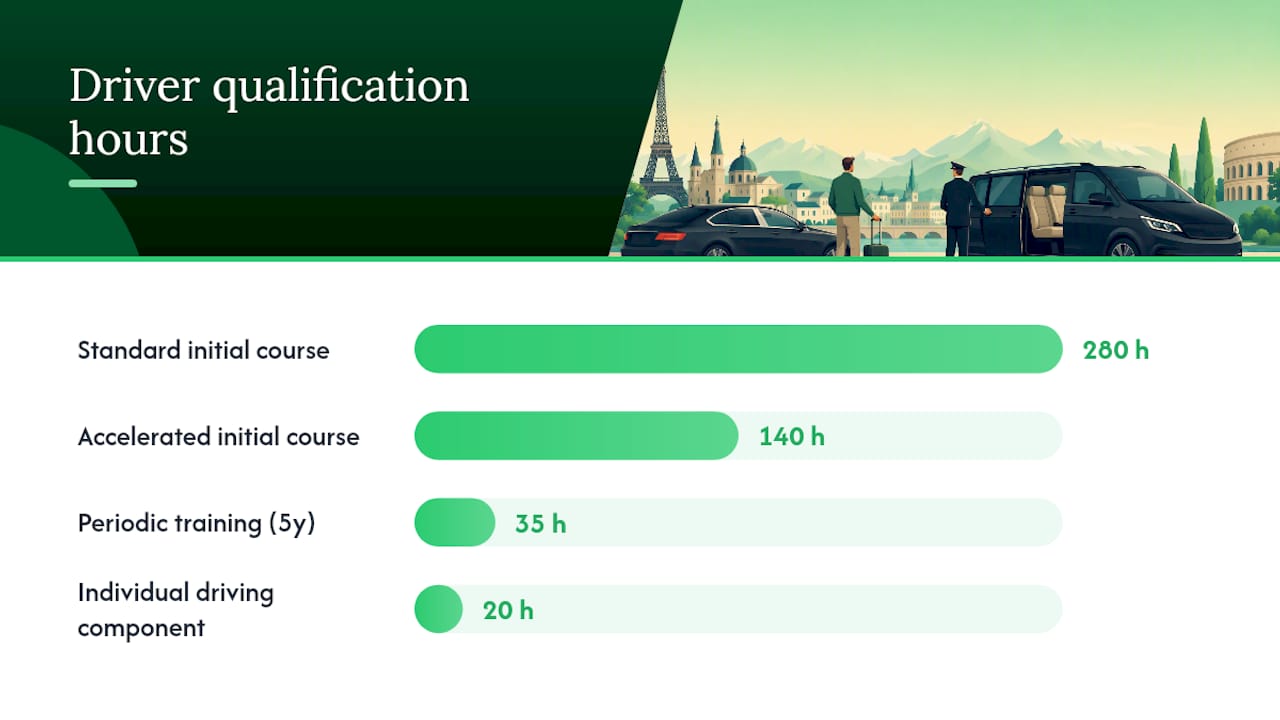
Directive (EU) 2022/2561 requires professional passenger-vehicle drivers to complete an initial qualification before they carry paying passengers commercially. There are three routes: a standard 280-hour course (including 20 hours of individual driving), an accelerated 140-hour course, or a combination of theoretical and practical tests. After that, drivers must complete at least 35 hours of periodic training every five years to keep their CPC current. The code ‘95’ stamped on a driving license or driver qualification card is mutually recognized across all EU Member States, so a qualified driver in France is recognized in Germany, Spain, or Poland without re-examination.
| Qualification route | Hours required | Driving component |
|---|---|---|
| Standard initial course | 280 hours | 20 hours individual driving |
| Accelerated initial course | 140 hours | 20 hours individual driving |
| Theoretical + practical tests | Exam-based | Practical test included |
| Periodic training (every 5 years) | 35 hours | Varies by module |
Operator standards under Regulation 1071/2009
Regulation (EC) No 1071/2009 sets four criteria every road transport operator must meet: good repute, financial standing, professional competence, and effective establishment in a Member State. Operators must also designate a transport manager who is personally responsible for compliance. National electronic registers (ERRU) track operator records across the EU, so a company that loses its license in one country cannot simply reopen in another. For you as a traveler, this means a properly registered operator has cleared meaningful legal and financial hurdles before they ever pick you up.
Is your transfer a package, an LTA, or just a standalone booking?
The classification matters more than most travelers realize, and Directive 2015/2302 gives you the decision rules.
A package exists when two or more travel services (flight + hotel, or flight + transfer + hotel) are sold under a single contract, or when they are combined before the price is agreed. Packages carry the strongest protections: the organizer is fully liable for proper performance, insolvency protection is mandatory, and price increases above a certain threshold give you the right to cancel without penalty.
A linked travel arrangement (LTA) arises when you book a second service by clicking through from one supplier’s site to another within 24 hours, and your personal data is passed between them. ECC-Net explains that LTAs carry narrower protections: each trader is responsible only for the service they sold, and you do not get the same organizer-level liability as in a package.
A standalone transfer is simply a point-to-point booking with no link to other services. Your Europe notes that standalone transfers give you the weakest statutory protections, which is why the supplier’s own service guarantees matter so much.
The “minor transport” test. ABTA’s commentary on Recital 17 of Directive 2015/2302 explains that most airport-to-hotel transfers are classified as “minor transport services” and therefore do not count as a standalone travel service for package-building purposes. The test is fact-specific: a short hotel shuttle is almost always minor, but a long-distance coach transfer that represents a significant share of the trip’s value could be treated differently.
Quick decision rules at booking:
- Was the transfer advertised as part of a holiday package? → Package protections apply.
- Did you click from a flight or hotel booking site to a transfer site within 24 hours, and did the first site pass your details to the second? → Likely an LTA.
- Did you book the transfer independently, weeks apart from other services? → Standalone, rely on the supplier’s own terms.
What safety and compliance signals should you look for?
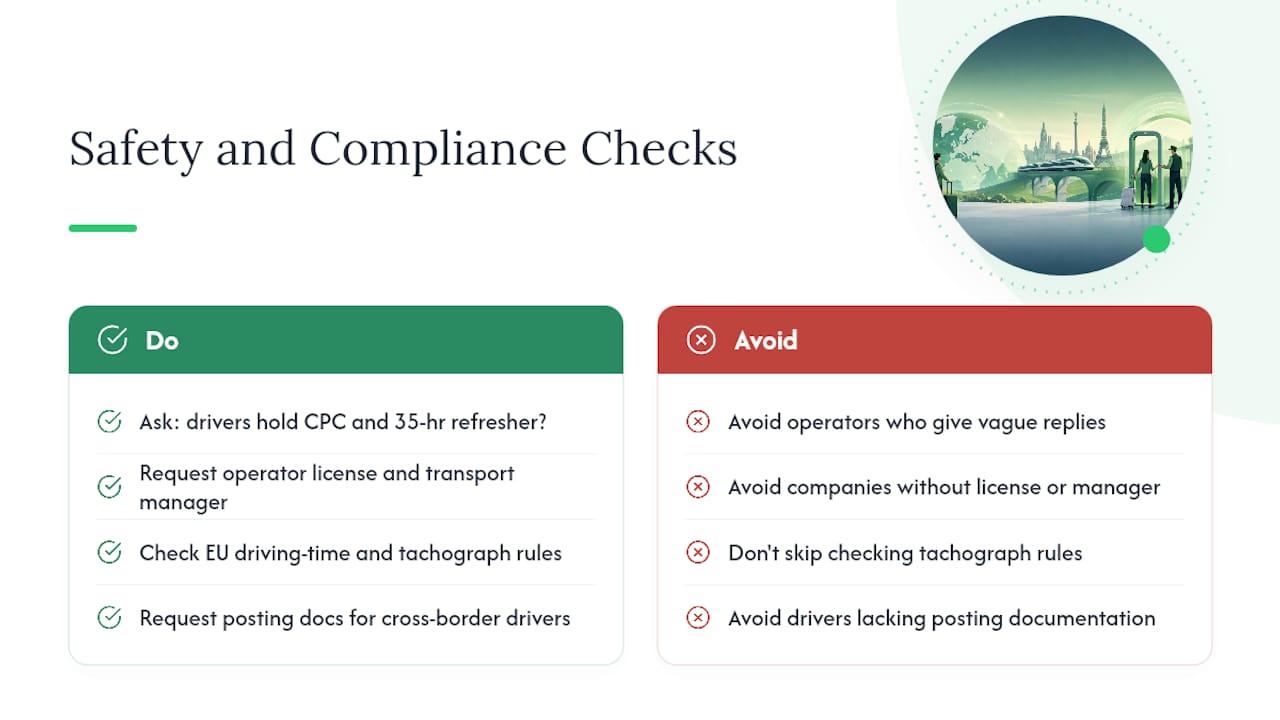
CPC/code ‘95’ is the clearest credential to request. A driver who holds it has completed structured training in safe driving techniques, cargo security, health and safety, and customer service. The periodic 35-hour refresher every five years means that training is not a one-time box-tick.
At the operator level, look for a company that can confirm it holds a road transport operator license and has a named transport manager. That person is legally accountable for the fleet’s compliance, which creates a real incentive to maintain standards rather than cut corners.
For longer transfers or coach services, EU driving-time and tachograph rules apply to heavy vehicles and buses. These rules cap daily and weekly driving hours and require rest periods, directly affecting punctuality and driver alertness on multi-hour routes. For a standard sedan or minivan airport transfer, tachograph rules typically do not apply, but it is worth confirming for any journey over two hours in a larger vehicle.
Cross-border transfers add one more layer. Drivers operating across EU borders may be subject to posting rules and must carry documentation proving their employment terms. Schengen zone travel removes passport checks at most internal borders, which simplifies logistics, but the employment and driving-time rules still apply regardless of border formalities.
Pro Tip: Ask the operator directly: “Can you confirm your drivers hold a current CPC or code ‘95’?” A reputable company will answer immediately. Hesitation or a vague reply is a signal worth noting.
What rights and remedies do you have if something goes wrong?
If your transfer is part of a package, the organizer is liable for the proper performance of all services in it, even those provided by third parties. You are entitled to assistance if you are stranded, repatriation in serious cases, and a refund or price reduction if services fall short. Price increases above 8% of the total package price give you the right to cancel and receive a full refund. Insolvency protection is mandatory, so your money is covered if the organizer goes under before your trip.
If your transfer is an LTA, each trader is responsible only for their own service. You can complain to the transfer company directly, and if they fail to resolve it, escalate to the relevant national authority or the ECC-Net.
If your transfer is standalone, your remedies depend on the supplier’s terms and general consumer law in the country where the service was provided.
Step-by-step complaint process:
- Contact the supplier’s customer support immediately, in writing, stating the problem and what remedy you want.
- Keep all evidence: booking confirmation, payment receipts, timestamps, photos, and any written communication.
- If the supplier does not respond within a reasonable period (typically 14 days), file a complaint with the national consumer authority in the country where the transfer took place.
- For cross-border disputes, contact ECC-Net, which handles EU consumer disputes involving travelers from outside the EU, including Americans.
- If you paid by credit card, contact your card issuer about a chargeback for services not rendered or materially different from what was described.
- As a last resort, contact the US consulate or embassy in the relevant country for guidance on local legal resources.
Your booking checklist for private transfers in Europe
Before you confirm any private airport or chauffeur transfer in Europe, work through this list:
- CPC/code ‘95’: Confirm the driver holds a current certificate. Ask directly or check the booking confirmation.
- Operator license: Verify the company is a registered road transport operator with a transport manager. A reputable chauffeur service will state this clearly.
- Flight tracking: Does the service monitor your flight and adjust pickup automatically for delays?
- Free waiting time: How long will the driver wait if your flight is late, at no extra charge?
- 24/7 support: Is there a real person available around the clock, not just a chatbot?
- Fixed, transparent pricing: Is the quoted price final, with no surge charges or hidden fees?
- Cancellation terms: What is the deadline for a free cancellation, and how is the refund processed?
- Insolvency or payment protection: Is your payment held securely, and what happens if the company cannot fulfill the booking?
Pro Tip: Ask the supplier: “Is this transfer sold as part of a package or as a standalone service?” The answer tells you immediately which set of EU protections applies to your booking, and a supplier who cannot answer clearly may not understand their own legal obligations.
What to do immediately if a transfer fails
- Document everything on the spot. Photograph the meeting point, note the exact time, and screenshot any app status showing the driver’s location or absence.
- Call the supplier’s 24/7 support line. State the problem clearly and ask for a replacement vehicle or a refund authorization in writing.
- Keep all receipts. If you have to arrange alternative transport, save every receipt. You will need these for a reimbursement claim.
- Send a written complaint within 24 hours. Email is sufficient. State the booking reference, what failed, what you spent as a result, and what remedy you expect.
- Escalate to ECC-Net or your card issuer if the supplier does not respond or refuses a reasonable remedy within 14 days.
- Contact your consulate if you are stranded in an unfamiliar city without transport and cannot reach the supplier or arrange alternatives independently.
Why Zont Cab is built around these exact standards
Travelers who want a transfer that already meets the checks above will find that Zont Cab’s airport transfer service across Europe is designed around them. Flight tracking is built into every booking, with free waiting time for delayed arrivals. Drivers are vetted for professional qualifications, and the company operates across 120+ European cities with 24/7 multilingual support available by phone and app.
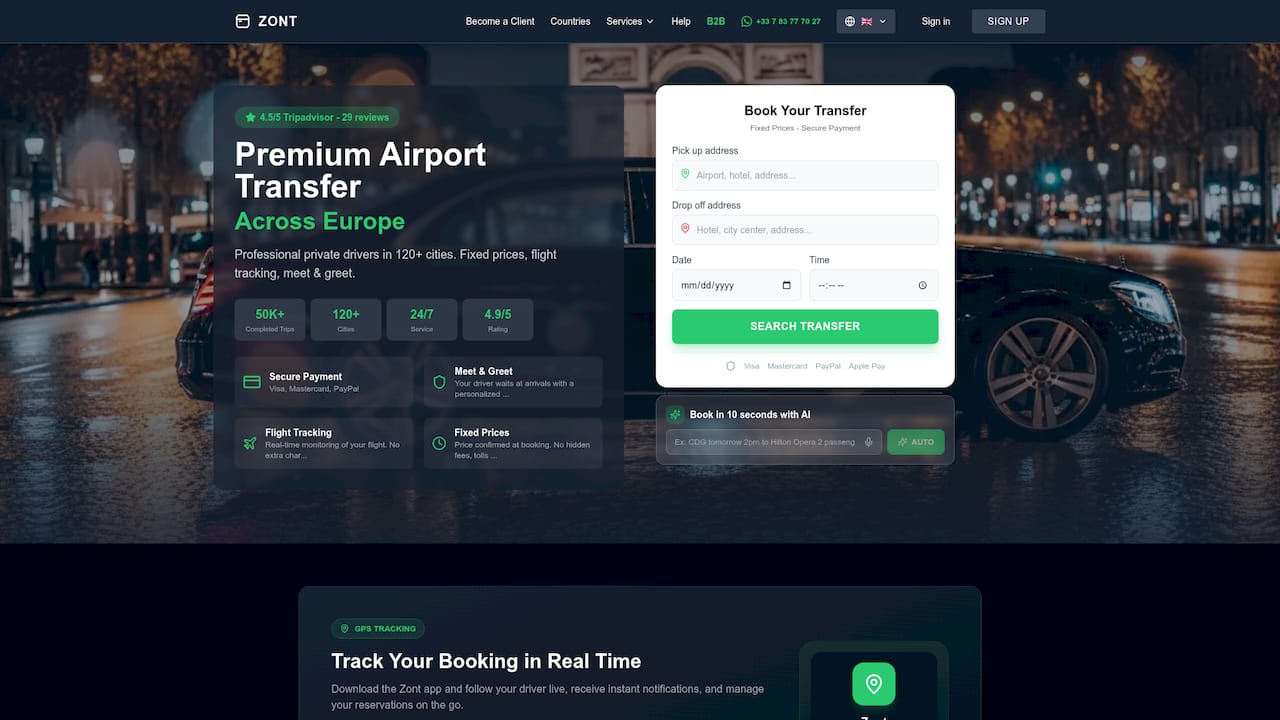
Pricing is fixed at booking, with no hidden fees and clear cancellation terms stated before you pay. With 50,000+ completed trips and a 4.5-star TripAdvisor rating, the track record backs the promise. For families needing a Mercedes V-Class minivan or business travelers who want a sedan with meet-and-greet at arrivals, browse available destinations and book directly.
A note from Arthur on what actually goes wrong at European airports
The regulatory framework is solid, but the real problems travelers face are almost never about the rules themselves. They are about the gap between what was booked and what shows up. A driver waiting at the wrong terminal, a phone number that rings out at 2 AM, a price that doubles because of a “peak surcharge” that was never mentioned. Those are not regulatory failures; they are supplier failures that the regulations were designed to prevent but cannot enforce on your behalf in real time.
The single most effective thing you can do is book with a company that has a live support line and a named driver assigned before you land. When a flight diverts or a connection is missed, the difference between a stressful hour and a resolved situation is usually one phone call to someone who already knows your booking and has the authority to act on it.
Sources
For the full legal texts and consumer help resources, consult these official sources directly:
- Drivers of road vehicles for the carriage of goods or passengers – qualification and training | EUR-Lex
- Rules governing access to the profession - Mobility and Transport
- Package travel, package holidays and linked travel arrangements in the EU - Your Europe
- If you book a linked travel arrangement in the EU, Norway or Iceland - ECC-Net
- Package travel regulations: are transfer services ‘carriage of passengers’?