Why Is a Flight Number Required for Transfer Booking?

Your flight number is the single piece of information that allows an airport transfer service to monitor your arrival in real time and coordinate your driver’s timing accurately. Without it, the entire pickup depends on a published schedule that airlines routinely miss. Understanding why flight number is required for transfer booking clarifies what separates a reliable pickup from a frustrating wait at the curb.
Why is a flight number required for transfer booking?
A flight number connects your booking to live aviation data, turning a static reservation into a dynamic, self-adjusting service. Flight tracking APIs cover over 97% of global commercial flights with updates every 15 seconds. That refresh rate means your transfer provider knows your plane’s status almost as fast as the airline does.
The flight number acts as a lookup key. Transfer platforms feed it into aviation data APIs that return real-time status: gate departure, wheels-up, wheels-down, and taxi-in. Each milestone triggers a calculation. The system estimates your curb-side arrival time and adjusts the driver’s schedule accordingly, without any phone call from you.
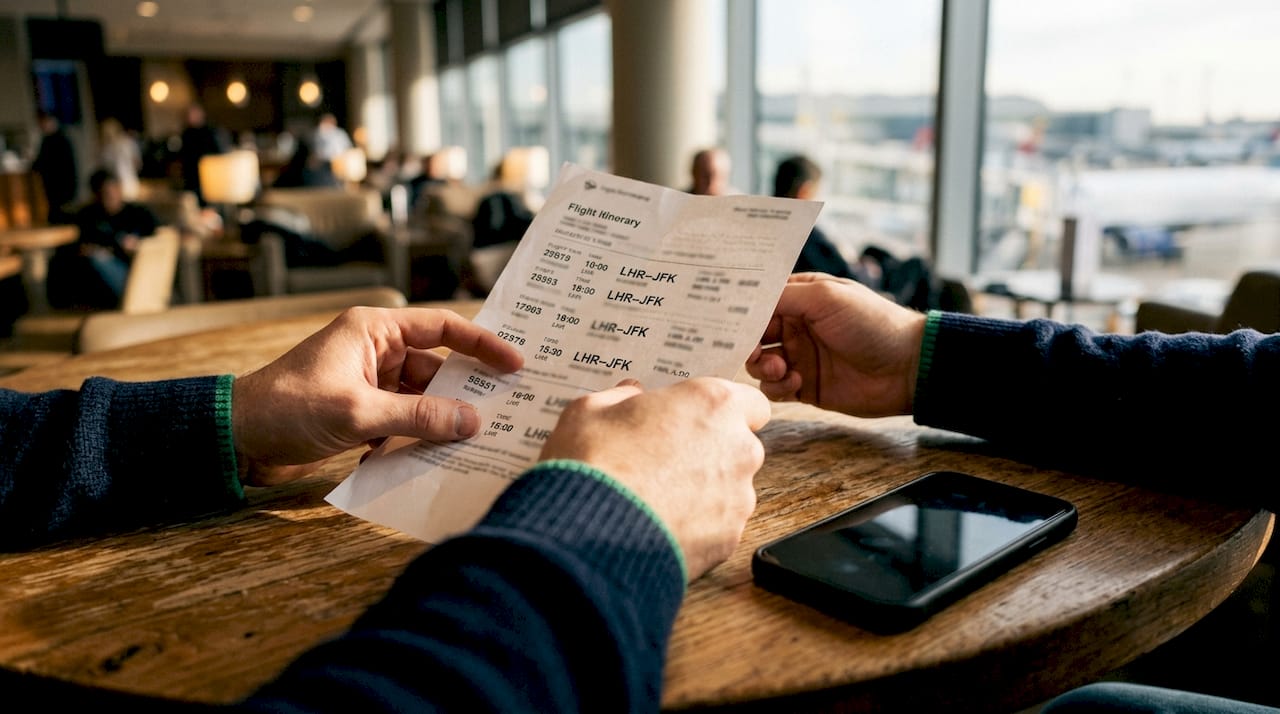
This is what separates airport transfers from standard rides. A standard point-to-point ride moves on a fixed clock. An airport transfer moves on your flight’s clock. The flight number is the link between those two clocks.
How flight numbers enable real-time tracking and pickup coordination
Professional transfer operators build their dispatch workflows around flight milestones. Flight numbers enable tracking of takeoff, landing, and taxi-in to calculate a precise curb-side ETA. Each milestone feeds a scheduling algorithm that tells the driver exactly when to leave for the terminal.
The key milestones the system monitors are:
- Takeoff confirmation: The system locks in your flight as active and begins countdown calculations.
- Landing signal: The driver receives an updated ETA and moves toward the terminal.
- Taxi-in and gate arrival: The system applies a buffer window to account for disembarking and baggage claim.
- Baggage claim buffer: Standard buffer times run approximately 20 minutes for domestic arrivals and 45 minutes for international arrivals.
Those buffer times exist because landing does not mean you are at the curb. International travelers clear customs, collect bags, and walk to the exit. The 45-minute international buffer reflects that reality. Domestic passengers move faster, so the buffer shrinks.
Pro Tip: When you book, use the exact flight number printed on your boarding pass or e-ticket, such as “LH441” rather than just “Lufthansa.” The system cannot search by airline name alone.
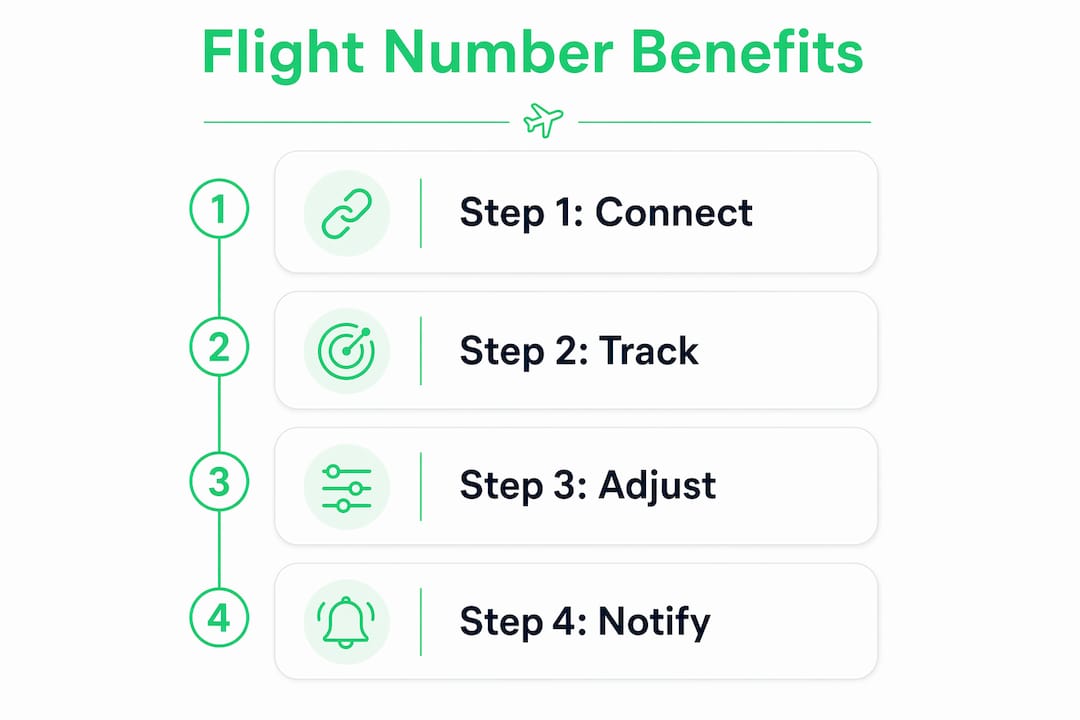
The driver dispatch trigger fires automatically when the system detects your flight has landed and the buffer window begins. No manual intervention is needed. The driver arrives at the right time because the system calculated it from your actual flight data, not a guess.
What happens when a flight number is missing or wrong?
Missing or inaccurate flight numbers force operators into a reactive mode that rarely ends well. Not providing a flight number is a red flag, because it prevents real-time tracking and forces the operator to rely on the scheduled arrival time only.
Here is what that looks like in practice:
- Driver arrives too early. The scheduled time says 2:00 PM. Your flight lands at 2:40 PM. The driver waits 40 minutes, burning fuel and blocking the pickup zone.
- Driver arrives too late. Your flight lands early at 1:30 PM. You clear customs by 2:10 PM and find no one waiting. You call, wait, and miss a connection.
- Missed pickup. In busy airports like Frankfurt or Paris CDG, a driver who cannot locate a passenger within a short window may leave. You are now stranded.
- Higher operational costs. Idle driver time raises the provider’s labor and fuel costs. Those costs eventually show up in pricing or service cuts.
A transfer provider that does not ask for your flight number during booking is telling you something important. It means their service runs on schedules, not live data. That is a structural weakness, not a minor inconvenience. Providing your flight number at booking allows monitoring to begin immediately, giving the provider maximum time to react to any changes.
How flight numbers handle delays, early arrivals, and disruptions
Flight disruptions are common. Weather, air traffic control holds, and mechanical issues push flights off schedule constantly. A flight number linked to live data means your transfer adapts automatically.
Flight-integrated dispatch adjusts pickup times dynamically in response to delays or early arrivals without charging extra or requiring you to call anyone. Your price stays locked at the rate you booked. The driver’s schedule shifts to match your new arrival time.
The table below shows how the system responds to common disruptions:
| Disruption type | System response | Traveler action needed |
|---|---|---|
| Flight delayed 30–90 minutes | Driver ETA automatically updated | None |
| Flight arrives 20 minutes early | Buffer window absorbs the difference | None |
| Flight cancelled | Booking automatically flagged for review | Contact provider to rebook |
| Flight diverted to alternate airport | System cannot auto-reroute | Call provider immediately |
The diversion case is the one exception where automation stops. Airport diversions require manual intervention because the destination airport changes, which alters the route distance and pricing. No tracking system can rebook a car to a different city on its own. If your flight diverts, call your transfer provider as soon as you land.
Pro Tip: Save your transfer provider’s contact number in your phone before you board. If a diversion happens, you will want to reach them fast, not search for the number while standing in an unfamiliar terminal.
Flight cancellations trigger what operators call an “orphaned booking” protocol. The system detects the cancellation through the flight number, flags the associated transfer, and removes the driver from that assignment. That keeps the driver available for other pickups and prevents unnecessary costs from piling up.
Practical tips for giving accurate flight details when booking
Getting the most from a flight-tracked transfer service starts before you even reach the airport. The quality of the information you provide at booking directly determines how well the system can serve you.
Follow these steps every time you book:
- Use the exact flight number. Write it as it appears on your boarding pass: carrier code plus digits, such as “BA249” or “AA103.” Do not write “British Airways” or “American Airlines” alone.
- Include both airports. Specify your departure airport and your arrival airport. Codeshare flights sometimes operate under different numbers at different legs.
- Add your scheduled arrival time. Even though the system tracks live data, the scheduled time helps the provider set up the initial booking correctly.
- Update the provider if your flight changes. If you rebook onto a different flight number, the old tracking link breaks. Notify your provider with the new number as soon as possible.
- Book early and share the number at booking. Sharing your flight number late reduces the time the system has to monitor your flight and react to early changes.
The most common mistake travelers make is writing only the airline name in the booking notes. That tells the system nothing. A flight number is a unique identifier. An airline name is not.
Understanding why early arrivals create problems for transfer providers reinforces why the exact number matters. Early arrivals are actually harder to handle than delays, because the system needs a confirmed landing signal to start the buffer countdown. Without the flight number, there is no signal to detect.
Key Takeaways
A flight number is the operational backbone of every reliable airport transfer, connecting your booking to live aviation data that drives automatic driver dispatch and timing adjustments.
| Point | Details |
|---|---|
| Flight number links to live data | It connects your booking to real-time flight APIs that update every 15 seconds. |
| Buffer times protect you | Providers apply 20-minute domestic and 45-minute international buffers after landing. |
| Missing numbers cause failures | No flight number forces reliance on schedules, increasing the risk of missed pickups. |
| Disruptions are handled automatically | Delays and early arrivals trigger automatic driver ETA updates at no extra charge. |
| Diversions need a phone call | If your flight lands at a different airport, contact your provider immediately. |
The detail most travelers overlook
I have seen more transfer failures caused by a missing flight number than by traffic, bad weather, or driver error combined. Travelers assume the booking is complete once they enter a pickup address and a time. The flight number feels like optional extra information. It is not.
The operational reality is that a transfer without a flight number is a gamble. The driver shows up at the scheduled time and hopes for the best. That worked in an era before live aviation APIs. It does not work now, when flights routinely deviate from their published schedules by 30 minutes or more in either direction.
What changed in recent years is not the importance of the flight number. It has always mattered. What changed is that technology now makes it possible to act on that data automatically. Providers who have built flight-integrated dispatch systems have essentially removed the human error from pickup timing. Providers who have not built those systems are still guessing.
My advice is simple: treat the flight number field as mandatory, even when the booking form marks it optional. Share it at the time of booking, not the night before. And if your itinerary changes, update your provider before you assume the system will figure it out on its own.
— Arthur
Zont Cab’s flight-tracked transfers across Europe
Zont Cab builds flight number tracking into every airport transfer booking as a standard feature, not an add-on.
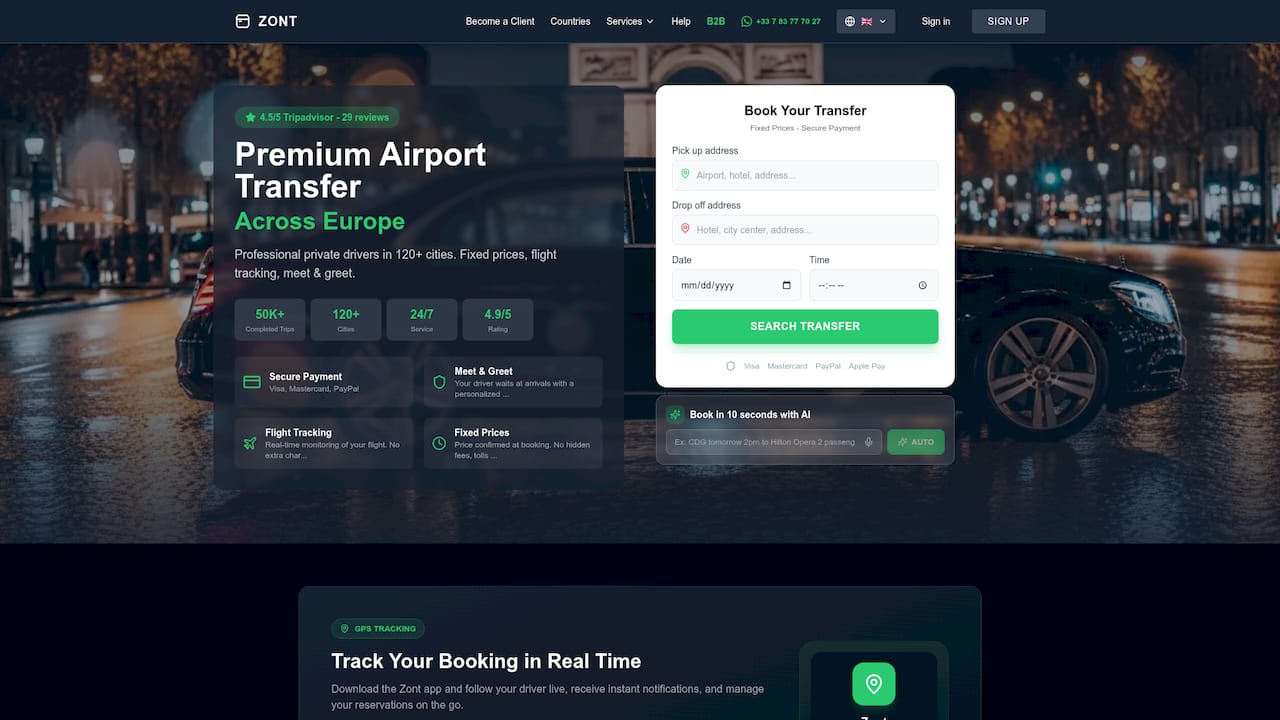
When you book with Zont Cab, your flight number connects directly to live aviation data. The system monitors your flight from takeoff to taxi-in, adjusts your driver’s schedule automatically, and holds your fixed price regardless of delays. Zont Cab operates airport transfers across Europe in over 120 cities, covering major hubs and regional airports alike. Every booking includes a meet and greet service, a professional driver, and a premium vehicle. With over 50,000 completed trips and a 4.5-star TripAdvisor rating, Zont Cab delivers the reliability that flight-integrated dispatch makes possible.
FAQ
Do I need a flight number to book an airport transfer?
Yes. A flight number is required for the transfer service to monitor your arrival in real time and dispatch your driver at the right moment. Without it, the provider can only rely on your scheduled arrival time, which is often inaccurate.
What if I don’t know my flight number yet?
Book the transfer with your best available details and add the flight number as soon as your ticket is confirmed. Providing the number early gives the system maximum time to begin monitoring your flight status.
Can a transfer service track my flight without the number?
No. Flight tracking APIs require a specific flight number to pull live status data. An airline name or route description alone does not return usable tracking information.
What happens to my transfer if my flight is cancelled?
Flight number tracking detects the cancellation automatically and flags your booking for review. Contact your transfer provider to rebook on a new flight, and share the updated flight number immediately.
Does my transfer price change if my flight is delayed?
No. Flight-integrated dispatch adjusts your pickup time automatically without changing the price you locked in at booking. The only exception is a diversion to a different airport, which requires a manual rebooking.