Flight Cancellation Transfer Procedure: What to Do Now

When your airline cancels a flight, a pre-booked transfer with flight-tracking will typically hold or reschedule your booking without surprise fees — provided the cancellation was airline-initiated and you notify the provider quickly. The key word is quickly. Many providers measure your credit tier from your original scheduled pickup time, not from when you eventually get rebooked. Contact your transfer provider before you join the airline rebooking queue.
Here is what to do right now:
- Read the airline’s cancellation message and note your new flight number and arrival time.
- Call or message your transfer provider immediately, before anything else.
- Get written confirmation of any hold, reschedule, or credit issued.
- Save screenshots of all communications as evidence.
Table of Contents
- What happens right after your flight is canceled?
- How flight-tracking transfers handle cancellations automatically
- Reschedule vs. refund: what the typical transfer policy looks like
- What information you must give the provider after a cancellation
- On-the-ground scenarios: missed pickups and driver no-shows
- Payments, refunds, and when to dispute a charge
- How to pick a transfer provider that handles cancellations well
- Your pre-travel and post-cancellation checklist
- How the type of cancellation affects your transfer options
- Key Takeaways
- Why operational transparency is the real differentiator
- Zont Cab handles the disruption so you don’t have to
- Useful sources and further reading
What happens right after your flight is canceled?
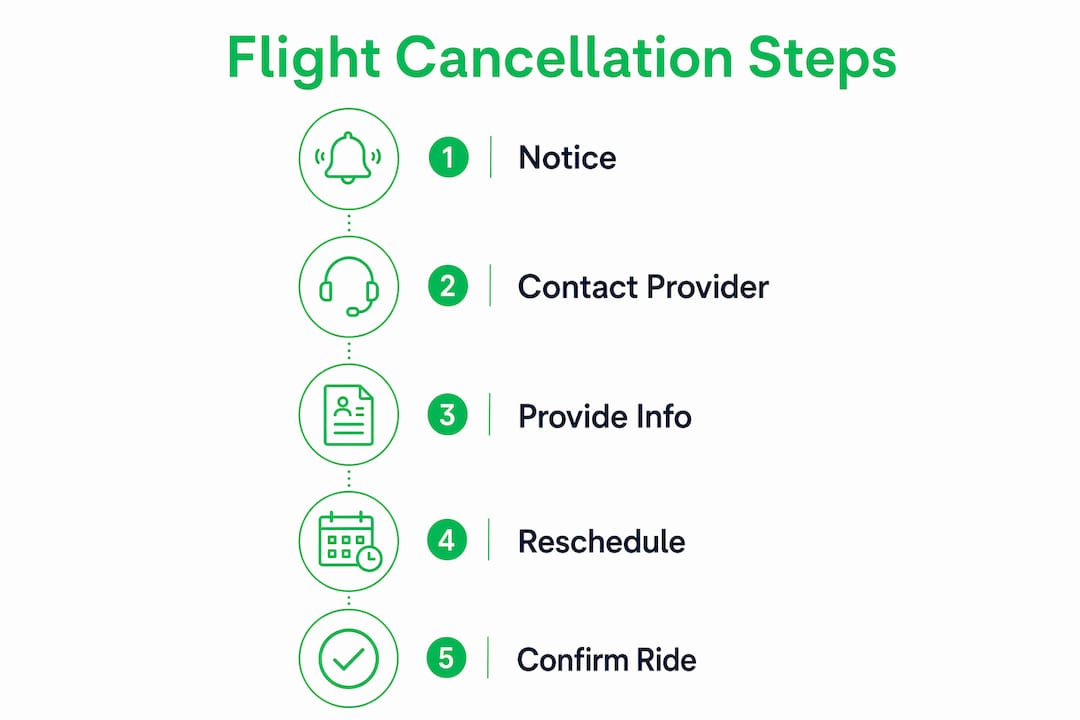
The moment an airline cancels a flight, two things should happen in parallel: the provider’s system flags the change, and you pick up the phone.
On the provider side, automated flight-monitoring alerts trigger when the booking’s linked flight number changes status to “cancelled” in global aviation feeds. The driver assignment is placed on hold. Depending on the provider’s rules, the booking either stays open pending your rebooking confirmation or is formally suspended until you make contact.
On your side, the clock is already running. Contact the provider before you join the airline queue, because some credit tiers are calculated from your original pickup time. A 30-minute delay in calling can drop you from a full credit to a partial one.
- Read the airline cancellation notice and note the new flight number.
- Call or message your transfer provider — SMS, WhatsApp, or the provider app all work.
- Confirm in writing that the booking is on hold, not cancelled.
- Then join the airline rebooking queue.
Pro Tip: Save your provider’s direct phone number and WhatsApp contact before you travel. Airport Wi-Fi is unreliable, and fumbling through a booking confirmation email at a gate is not the moment you want to be searching for a contact number.
How flight-tracking transfers handle cancellations automatically
When you provide a flight number at booking, the provider’s dispatch system links to aviation databases that push live status updates: on time, delayed, diverted, or cancelled. That link is what separates a premium transfer from a standard taxi booking.
In practice, the system works like this:
- Status update received: The feed flags your flight as cancelled.
- Booking placed on hold: The driver assignment is suspended automatically.
- Staff alerted: A dispatcher reviews the case and waits for your contact or the airline’s rebooking data.
- Pickup time adjusted: Once you confirm a new flight, the booking is reattached to the new arrival time.
The failure cases matter as much as the smooth ones. Diversions, cancellations without an immediate rebooked flight, and early arrivals can all break the automated link. If your new flight number is different from the original, the tracking system may not connect the dots on its own. Always send the new flight number in writing, even when the provider says they monitor everything.
Reschedule vs. refund: what the typical transfer policy looks like

The outcome of a cancellation depends on three things: who initiated it, how much notice you gave, and what the provider’s published terms actually say.
| Notice before original pickup | Airline-initiated cancellation | Passenger-initiated cancellation |
|---|---|---|
| More than 4 hours | Full credit or free reschedule | Full credit (most providers) |
| 2–4 hours | Partial credit or reschedule at same rate | Partial credit or fee |
| Under 2 hours | No credit, no refund | No refund |
These tiers come from published provider policies and are representative of how premium operators structure their terms. Your provider’s exact windows may differ, so read the terms at booking, not at the airport.
Refunds to a credit card typically take 5–10 business days after the provider processes the request. Provider credits are usually issued faster but may be non-refundable. Disputes with the payment processor take longer and require documentation.
A provider that publishes granular cancellation rules is less likely to create a dispute when you actually need support. Opaque terms are an operational red flag, not a minor inconvenience. Clear, published terms reduce confusion and support faster resolution when things go wrong.
What information you must give the provider after a cancellation
Getting this right prevents a no-show charge. The provider needs enough detail to reattach your booking to a real flight.
Minimum required:
- Your booking reference number.
- Original flight number and scheduled arrival time.
- New flight number and new scheduled arrival time.
- Your contact phone number (the one you’ll have at the airport).
- Any change to pickup location or terminal.
Helpful extras: A screenshot of the airline’s rebooking confirmation, your PNR, and the new gate or terminal if available.
A short message that covers everything: “Booking ref [XXXX]. Original flight [XX123] cancelled. Rebooked on [XX456], arriving [time], [terminal]. Please confirm the transfer is updated. Contact: [your number].” Send it by SMS or WhatsApp so there is a written record.
On-the-ground scenarios: missed pickups and driver no-shows
If the driver is late or absent
- Check the provider app and your messages for any update from dispatch.
- Call the provider’s support line directly — not the general booking line.
- Document the time, your location, and any messages received. Screenshots with timestamps matter.
- Follow the provider’s escalation steps, usually listed in the booking confirmation.
If your pickup was cancelled and you still need a ride
Ask the provider for on-demand options or a local partner they work with. Confirm any price difference in writing before you get in the vehicle. For connecting flight transfers or multi-leg disruptions, the original booking parameters rarely survive intact.
For extreme disruptions — a diversion, a next-day rebooking — treat it as a new booking. Get written confirmation of the route, price, and vehicle type before you travel.
Payments, refunds, and when to dispute a charge
Refunds flow from the provider first, then the payment processor. If the provider approves a refund, expect 5–10 business days for it to appear on your card. A provider credit is faster but typically non-refundable.
When to escalate:
- The provider refuses a refund that their published policy says you’re owed.
- You have written evidence of the cancellation and your timely notification.
- The provider is unresponsive after a reasonable window (48–72 hours).
Documentation checklist for a dispute:
- Booking receipt with original flight details.
- Written cancellation confirmation from the airline.
- Screenshots of your communications with the provider and timestamps.
- Airline rebooking evidence (new flight number, new itinerary).
Pro Tip: Pay for premium transfers with a credit card that offers travel protection. If the provider refuses a valid refund, a chargeback is your backstop — but you need the paper trail to win it.
Travel insurance can cover transfer costs when a cancellation is covered under your policy’s trip-interruption clause. Check your policy’s definition of “covered reason” before assuming it applies.
How to pick a transfer provider that handles cancellations well
The time to evaluate a provider’s cancellation process is before you book, not after your flight disappears from the departures board.
Operational-standards checklist:
- Published cancellation and reschedule policy with explicit time windows.
- Flight-tracking with stated wait-time guarantees (e.g., 45 minutes domestic, 90 minutes international).
- 24/7 support with direct phone, SMS, and WhatsApp access.
- Clear refund timeline stated in the terms.
- Written confirmation practice for any booking change.
- Verified customer ratings and completed-trips metrics.
- Fixed pricing that carries to rescheduled pickups without surcharges.
When evaluating shuttle alternatives for group travel, apply the same checklist. A provider that can’t answer “what happens if my flight is cancelled?” before you book will not answer it well at 11 PM in a foreign airport either.
Your pre-travel and post-cancellation checklist
Before you travel:
- Save the provider’s direct phone, SMS, and WhatsApp contact.
- Note your pickup window and grace period from the booking confirmation.
- Keep your booking reference and flight number accessible offline.
- Enable roaming or identify airport Wi-Fi options at your destination.
At cancellation:
- Read the airline message and note the new flight number and arrival time.
- Contact the transfer provider before joining the airline rebooking queue.
- Confirm the booking hold or next steps in writing.
- Screenshot everything with timestamps.
After rebooking:
- Send the new flight details to the provider in writing.
- Request SMS or email confirmation that the booking is reattached.
- Track the refund or credit timeline and follow up if it exceeds the published window.
How the type of cancellation affects your transfer options
Not all cancellations are equal, and the cause changes what you can expect from your provider.
Airline-initiated cancellations (mechanical, operational, staffing) are the clearest case for a full credit or free reschedule. Most providers treat these favorably because the passenger had no control.
Weather-related cancellations are trickier. Airlines classify them as extraordinary circumstances, which limits their own compensation obligations. Transfer providers may apply the same logic and offer credit rather than a cash refund. Read the terms carefully.
Last-minute passenger cancellations — where you decide not to travel — typically fall into the least favorable tier. Providers have already reserved a driver and vehicle. Expect a fee or no refund inside short notice windows.
For any flight disruption scenario, the written record of who cancelled and when is what determines the outcome.
Key Takeaways
A flight-tracking transfer protects you best when you act immediately, get everything in writing, and chose a provider with published cancellation terms before the disruption happens.
| Point | Details |
|---|---|
| Contact provider first | Reach out before joining the airline queue — credit tiers often run from your original pickup time. |
| Written confirmation is non-negotiable | Always get a written hold, reschedule, or credit confirmation to prevent a no-show charge. |
| Policy tiers vary by notice window | Full credit typically requires more than 4 hours’ notice; under 2 hours usually means no refund. |
| Cancellation type affects outcome | Airline-initiated cancellations get the most favorable treatment; passenger-initiated get the least. |
| Zont Cab | Offers real-time flight tracking, fixed pricing on rescheduled pickups, and 24/7 multilingual support across 120+ European cities. |
Why operational transparency is the real differentiator
The conventional wisdom is that premium transfers are about the vehicle. A Mercedes, a meet-and-greet, a professional driver. Those things matter, but they are not what saves you when your flight disappears from the board at 9 PM.
What actually saves you is a provider who has thought through the cancellation scenario in advance and written it down. Published wait-time guarantees, explicit credit tiers, a direct support line that answers at midnight — these are operational commitments, not marketing copy. A provider that can’t tell you their cancellation policy before you book is telling you something important about how organized they are when things go wrong.
The checklist in this article is worth running through at booking time, not after. Ask the question. If the answer is vague, that is your answer.
Zont Cab handles the disruption so you don’t have to
When a flight cancels, the last thing you want is a transfer provider you can’t reach. Zont Cab monitors your flight in real time, holds your booking automatically when a cancellation is detected, and carries your fixed price to any rescheduled pickup — no surcharges, no renegotiation. Multilingual 24/7 support means someone picks up whether you’re rerouted through Frankfurt or stuck at CDG at 2 AM.

With a 4.5-star TripAdvisor rating and over 50,000 completed trips across 120+ European cities, Zont Cab’s cancellation handling isn’t a promise buried in fine print — it’s a published standard. Check availability for your route and book with fixed pricing at Zont’s European destinations.
Useful sources and further reading
- Policy example: CGC Airport Transfers — cancellation and delay policy — detailed credit tiers, wait windows, and flight-cancellation rules from a published operator policy.
- Technical explainer: How transfer companies monitor flight status — how providers link bookings to aviation feeds and act on status changes.
- Operational guide: Flight disruption scenarios that affect your transfer — examples and best practices for common disruption types.
- Provider terms example: Zont Cab terms and conditions — published cancellation, rescheduling, and refund terms for reference.
- Extreme disruptions: Ground transport after a schedule disruption — guidance on treating diversions and multi-day delays as new bookings.
- Group transfer alternatives: How to choose shuttle bus companies — evaluation criteria for group or shuttle options when a private transfer is unavailable.